 listicle
Freightos Alternatives for Small Business
Table of Contents
- Why Small Businesses Look Beyond Freightos
- Best TMS for Small Business Shipping
- Freight-Calculator.com: Instant Quotes Without Registration
- Easyship: Multi-Carrier Platform for E-Commerce
- Shippo: API-First Shipping for Growing Businesses
- Pirate Ship: Zero-Cost Shipping for Small Sellers
- Freightquote by C.H. Robinson: LTL and FTL Freight
- GlobalTranz: Multimodal Logistics Management
- Freightview: Dedicated LTL Management System
- How to Choose a Freight Forwarder for Your Business
- Freight Shipping Cost Reduction Strategies
- Key Features to Compare Across Platforms
- Conclusion
Last Updated: August 14, 2026
Why Small Businesses Look Beyond Freightos
Small business owners often start with Freightos because it's well-known and accessible. But as shipping volumes grow or business models shift, the limitations become apparent. Freightos works well for certain use cases, primarily parcel shipping and some international routes, but it's a marketplace, not a direct freight forwarder. That distinction matters more than most realize.
The core issue isn't that Freightos is bad. It's that Freightos alternatives for small business exist because different businesses have different needs. Some need instant quotes without registration. Others need dedicated LTL management. Still others need multimodal logistics with real-time visibility. A marketplace that aggregates carriers is useful, but it adds a middleman layer that increases complexity and can obscure true landed costs.
This guide examines the best alternatives to Freightos for small business operations, focusing on platforms that deliver transparency, speed, and cost efficiency without unnecessary friction. Whether you're shipping ocean freight, managing LTL loads, or coordinating international moves, understanding your options changes how you approach logistics decisions.
Best TMS for Small Business Shipping
The best transportation management system (TMS) for small business shipping depends on your primary freight mode and volume. Most small businesses don't need enterprise-level complexity, they need clarity on costs, speed in getting quotes, and integration that doesn't require a technical team.

Freight-Calculator.com: Instant Quotes Without Registration
Freight-Calculator.com stands apart because it answers a specific pain point: small businesses need international shipping quotes fast, without sales pressure or account creation friction. The platform delivers instant calculations for ocean, air, and LCL cargo in under 30 seconds.
What makes this relevant as a Freightos alternative for small business is the directness. You're not querying a marketplace of carriers, you're accessing a licensed NVOCC and TSA-approved forwarder with 35 years of logistics experience. The company operates as a direct service provider, not an intermediary. That means your pricing reflects actual capacity and routing, not marketplace markups.
The integrated CBM calculator handles volume planning automatically. You enter dimensions and weight; the system calculates cubic meters and provides landed cost visibility across routes, equipment types, and sailing schedules. This matters for small businesses because accurate volume planning prevents costly overestimates and catches capacity constraints before you commit.
Data privacy is explicitly protected, information is never sold to competitors or third parties. For businesses shipping sensitive products or managing proprietary supply chains, this removes a category of risk that marketplace models can't fully address.
The registration-free approach isn't just convenience. It's a signal of confidence. If a platform requires signup before showing pricing, it's designed for sales conversations, not immediate decisions. Freight-Calculator.com inverts that: get the quote first, then decide whether to engage.
Easyship: Multi-Carrier Platform for E-Commerce
Easyship targets e-commerce businesses that ship across multiple carriers and need automation. The platform connects to over 550 courier services globally, including UPS, FedEx, USPS, and DHL Express.
The integration ecosystem is the main draw. Easyship connects directly to Shopify, WooCommerce, Etsy, and Amazon, pulling order data automatically. For small e-commerce teams, this eliminates manual label entry and reduces shipping errors.
Pricing starts at no cost for up to 50 shipments per month. The Plus plan runs $29 per month (billed annually) for up to 500 shipments. For small businesses, the free tier provides a realistic trial before committing budget.
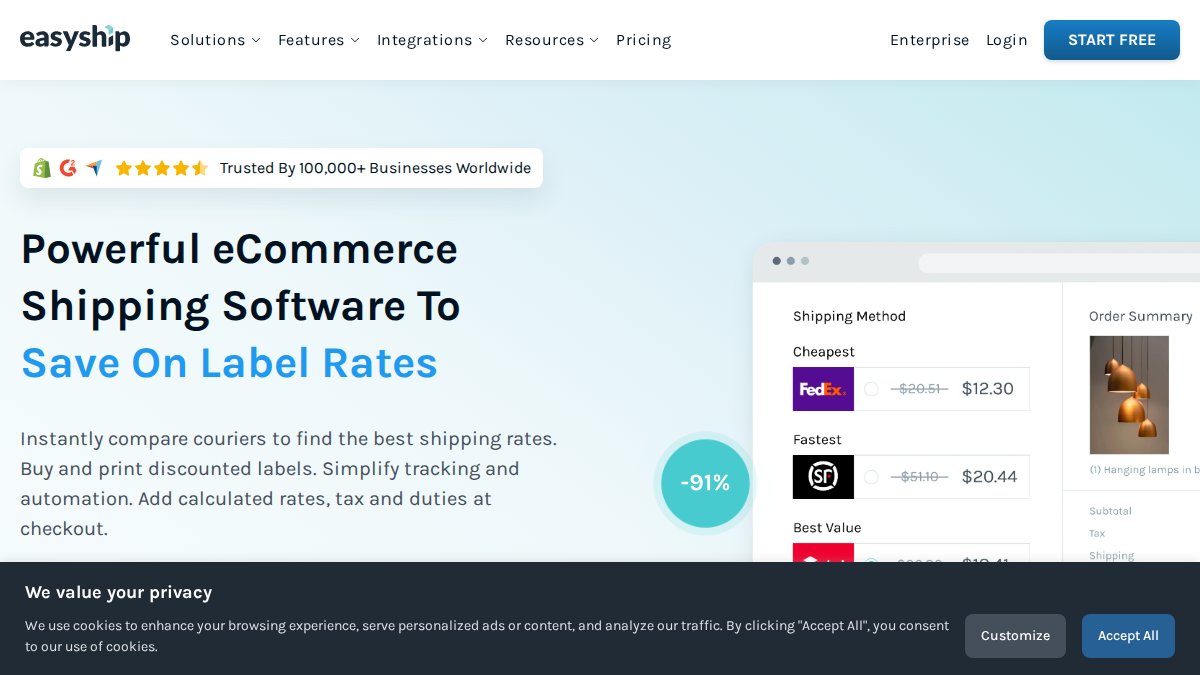
The platform calculates duties and taxes automatically for 220+ countries, which simplifies international fulfillment. Branded tracking pages let you maintain customer experience without exposing carrier logistics.
The drawback: Easyship is parcel-focused. If your business ships LTL or full truckload freight, this isn't the right tool. Also, customer support response times slow on lower-tier plans, which can be frustrating when you need help quickly.
Shippo: API-First Shipping for Growing Businesses
Shippo emphasizes automation and developer-friendly integration. The platform offers API access on all plans, including the free tier, which appeals to businesses building custom workflows.
The Starter plan is genuinely free for up to 30 labels per month. Pro plans range from $17 to $199 per month depending on volume. The pricing scales logically with business growth.
What differentiates Shippo is the automation rules engine. You can set conditions, if order weight exceeds X pounds, use FedEx; if destination is rural, use USPS, and Shippo executes automatically. For small teams managing multiple carriers, this removes repetitive decisions.
The free tier includes API access, which is unusual. If you're building a custom shipping system or integrating with proprietary software, Shippo's openness matters.
The limitation: the 30-label cap on the free plan gets exceeded quickly. Also, if you use your own carrier accounts rather than Shippo's negotiated rates, you pay $0.05 per label on the Starter plan, which adds up.
Pirate Ship: Zero-Cost Shipping for Small Sellers
Pirate Ship is genuinely free. No monthly fees, no label fees, no hidden costs. You pay only for postage, and the rates are deeply discounted USPS and UPS pricing.
The appeal for solo sellers and very small operations is obvious: zero friction on cost. If you're shipping 20-50 packages per month, Pirate Ship removes the need to evaluate pricing tiers.
The trade-off is carrier limitation. Pirate Ship works with USPS and UPS only. If you need FedEx, DHL, or international carriers, you're looking elsewhere.
Integration with major e-commerce platforms is limited. Pirate Ship doesn't have native Shopify or WooCommerce connectors, so order import requires manual CSV upload or API work on your side. For truly small operations, this might not matter. For growing businesses, it becomes tedious.
Freightquote by C.H. Robinson: LTL and FTL Freight
Freightquote addresses a specific gap: small businesses shipping LTL (less-than-truckload) or FTL (full truckload) freight. This is where Freightos alternatives for small business diverge sharply. Freightos doesn't compete here; Freightquote does.
The platform lets you get instant quotes from multiple LTL and FTL carriers without calling a broker. C.H. Robinson's scale means the rates reflect volume discounts typically reserved for larger shippers.
You can book, print labels, and track shipments online. The TMS tool is self-funded through a per-label fee, so there's no monthly subscription, you pay only when you ship.
The limitation: pricing isn't public. You need to request a quote to see actual rates. For businesses that want transparent pricing upfront, this adds friction.
GlobalTranz: Multimodal Logistics Management
GlobalTranz positions itself as a 3PL (third-party logistics) provider with a SaaS platform. The system integrates small parcel, LTL, truckload, and specialized services under one interface.
The carrier network includes over 45,000 truckload carriers and 75+ LTL carriers. For small businesses scaling across multiple shipping modes, this breadth is useful.
Real-time analytics and a "control tower" view give visibility across shipments. The platform starts at $20 per month, which is accessible for small operations.
The downside: implementation requires some learning. The platform is feature-rich, which means more complexity upfront. Also, $20 per month is the floor; actual pricing scales with services and volume.
Freightview: Dedicated LTL Management System
Freightview specializes in LTL freight management. If your business ships LTL regularly and works with multiple carriers, this is a focused solution.
The platform compares LTL rates, manages shipments from quoting to tracking, and provides reporting on shipping data. It handles bills of lading and integrates with business systems.
Starting price is $149 per month, which is higher than some alternatives but justified if LTL is your primary shipping mode. The platform improves efficiency and can reduce costs through better carrier selection.
The trade-off: Freightview is LTL-only. If you ship parcel, air, or ocean freight, you'll need additional tools.
How to Choose a Freight Forwarder for Your Business
Choosing the right freight forwarder requires evaluating several dimensions beyond just price. The best TMS for small business shipping balances cost, speed, integration, and support.
Start with your primary freight mode. Are you shipping parcel, LTL, FTL, ocean, or air? Most platforms specialize. A parcel-focused solution won't serve an LTL shipper well, and vice versa. Identify your core need first, then filter alternatives.
Next, assess registration friction. Do you need instant quotes without account creation, or are you comfortable with a registration step? Freight-Calculator.com eliminates registration entirely. Other platforms require signup before pricing visibility. For businesses that want to compare options quickly, registration-free matters.
Evaluate integration requirements. If you use Shopify, WooCommerce, or Etsy, check whether the platform connects natively. If you have custom systems, prioritize API access. If you're managing shipping manually, integration is less critical.
Consider support responsiveness. Cheaper platforms often offer email-only support. If you need help during business hours, that's a constraint. Premium tiers usually include phone support, which matters when shipments are delayed or rates don't match expectations.
Assess transparency on total cost of ownership. Some platforms show base rates but hide surcharges until you commit. Others, like Freight-Calculator.com, display landed costs upfront, origin fees, fuel surcharges, destination fees, all visible before you decide.
Freight Shipping Cost Reduction Strategies
Reducing freight shipping costs requires understanding what drives pricing, then optimizing within those constraints.
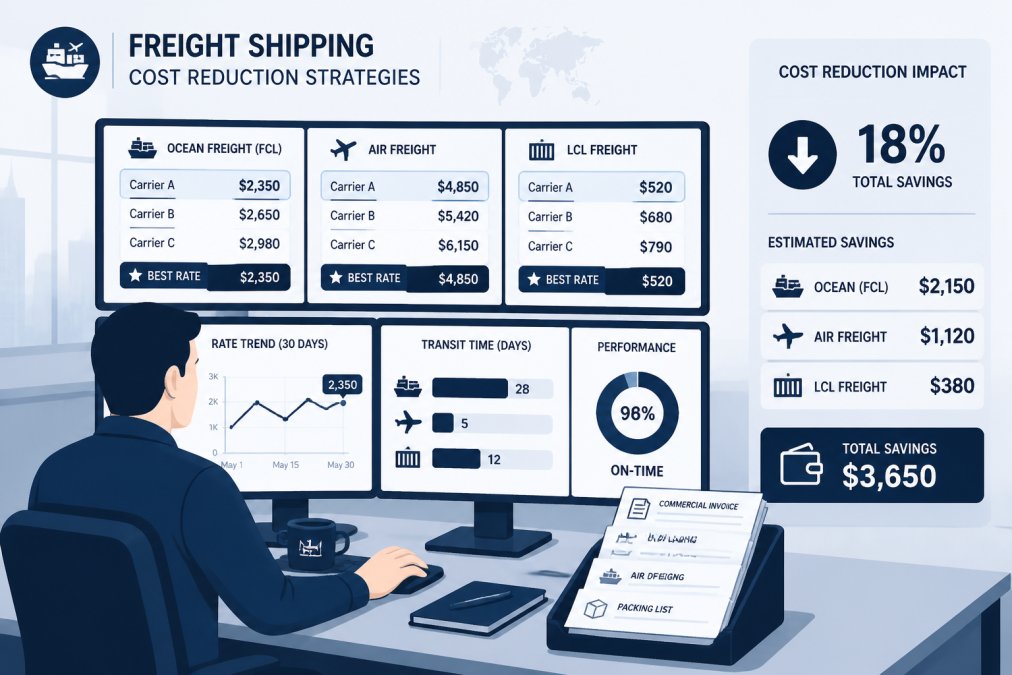
Volume consolidation is the most direct lever. Shipping one 20-foot container costs less per unit than shipping five 10-foot containers. If you can batch shipments and wait for consolidation, rates drop significantly. The trade-off is time. Consolidation requires waiting for capacity, which delays delivery.
Route optimization reduces unnecessary distance and handling. A shipment routed through a major hub adds days and cost. Direct routing, when available, is faster and cheaper. Freight-Calculator.com's route comparison tool shows these alternatives explicitly, so you can weigh time against cost.
Equipment selection impacts pricing. A full container load (FCL) is cheaper per unit than less-than-container load (LCL). Air freight is faster but more expensive than ocean. LTL is more expensive per pound than full truckload. The choice depends on urgency and volume. For small businesses, mixing modes, air for time-sensitive items, ocean for bulk, optimizes across shipments.
Carrier negotiation works if you have consistent volume. Carriers offer better rates to shippers with predictable, regular business. If you're shipping sporadically, you won't get preferred rates. Platforms like Freightquote and GlobalTranz aggregate volume across multiple shippers, which gives small businesses access to negotiated rates they couldn't achieve alone.
Documentation accuracy prevents costly delays and re-rates. Inaccurate weight, dimensions, or classification leads to surcharges at pickup or delivery. Freight-Calculator.com's integrated CBM calculator ensures dimensions are correct before quoting. This prevents the common scenario where a quote looks good, but actual measurements trigger additional fees.
Timing flexibility saves money. Shipping on Tuesday costs less than Friday. Off-peak seasons have lower rates. If your business can shift shipment timing slightly, rates drop noticeably. This requires coordination with your sales and operations teams, but the savings justify it.
Compliance and documentation automation reduces errors and fees. Customs documentation, bills of lading, and tariff classification require accuracy. Mistakes trigger delays and penalties. Platforms that automate documentation reduce this risk.
Key Features to Compare Across Platforms
When evaluating Freightos alternatives for small business, compare these features systematically.
| Feature | Freight-Calculator.com | Easyship | Shippo | Pirate Ship | Freightquote | Freightview |
|---|---|---|---|---|---|---|
| Registration Required | No | Yes | Yes | Yes | Yes | Yes |
| Primary Freight Mode | Ocean, Air, LCL | Parcel | Parcel | Parcel | LTL, FTL | LTL |
| Quote Speed | <30 seconds | Minutes | Minutes | Minutes | Minutes | Minutes |
| Carrier Network | Direct forwarder | 550+ couriers | Multiple carriers | USPS, UPS | Multiple LTL/FTL | Multiple LTL |
| API Access | Limited | Yes | Yes | No | Yes | Yes |
| Starting Price | Quote-based | Free | Free | Free | Quote-based | $149/month |
| E-commerce Integration | Limited | Excellent | Excellent | Limited | No | No |
| Data Privacy | Explicit (no resale) | Standard | Standard | Standard | Standard | Standard |
| Landed Cost Visibility | Full | Partial | Partial | Full | Partial | Partial |
The table shows clear segmentation. Parcel-focused platforms (Easyship, Shippo, Pirate Ship) serve e-commerce businesses. Freight-focused platforms (Freightquote, Freightview) serve logistics operations. Freight-Calculator.com occupies a unique position: international ocean and air freight with registration-free instant quoting.
Conclusion
Choosing a Freightos alternative depends on what Freightos doesn't deliver for your specific operation. If you're shipping international ocean or air freight and need instant quotes without registration, Freight-Calculator.com eliminates the middleman marketplace and connects you directly to a licensed forwarder with 35 years of logistics experience. The platform's integrated CBM calculator, transparent landed cost visibility, and data privacy protection address the core frustrations small businesses face with marketplace models. Get started with Freight-Calculator.com and replace days of quote waiting with 30-second pricing clarity.
Frequently Asked Questions
What makes Freight-Calculator.com different from Freightos for small business shipping?
Freight-Calculator.com provides instant international shipping rates in under 30 seconds without requiring registration, whereas Freightos operates as a marketplace. As a licensed freight forwarder with 35 years of logistics experience, Freight-Calculator.com offers direct service with transparent pricing and no data sharing with competitors. Your shipment information remains private, and you get real-time ocean, air, and LCL cargo quotes immediately without sales pressure or waiting days for a traditional freight quote.
How do I choose a freight forwarder when comparing multiple platforms?
Evaluate based on your specific shipping mode (ocean, air, LTL, or parcel), required features (rate comparison, real-time tracking, customs documentation), integration needs with your existing systems, support responsiveness for your business size, and total cost including any hidden fees. Check whether the platform requires registration, how quickly you receive quotes, and whether you get direct access to a licensed forwarder or a marketplace broker. Request sample quotes for your typical shipment to compare accuracy and transparency.
What are the most effective freight shipping cost reduction strategies for small businesses?
Consolidate shipments to reduce per-unit costs, compare rates across multiple carriers and routes in real-time, understand freight classification and density to avoid overpaying, negotiate volume commitments if you ship regularly, use less-than-container load (LCL) for smaller volumes instead of full container load (FCL), and optimize your cargo volume planning with integrated tools. Choose off-peak sailing schedules when possible, and work with a forwarder who provides landed cost visibility so you see exactly where costs occur and can identify savings opportunities.
Can I get accurate freight quotes without registering or talking to a salesperson?
Yes. Freight-Calculator.com delivers instant, registration-free quotes in under 30 seconds for international ocean, air, and LCL cargo. You enter your shipment details once and receive transparent pricing immediately. Other platforms like Pirate Ship (for USPS and UPS) and Shippo also offer free tiers with instant quotes. However, for specialized freight services like international consolidation or customs brokerage, most platforms require at least minimal information entry, though not necessarily full account registration.
This article was written using GrandRanker