 listicle
Best Freight Forwarder for E-Commerce in 2026
Table of Contents
- What to Look for When Choosing a Freight Forwarder for E-Commerce
- Top Freight Forwarders for E-Commerce: Feature Comparison
- 3PL vs Freight Forwarder for E-Commerce: Key Differences
- Freight Forwarding Costs for Small Business: What to Expect
- Amazon FBA Freight Forwarder Requirements: Meeting Compliance Standards
- Ocean vs. Air Freight for E-Commerce: When to Use Each
- How to Evaluate and Select the Right Freight Forwarder
- Conclusion
Last Updated: August 10, 2026
What to Look for When Choosing a Freight Forwarder for E-Commerce
Selecting the right freight forwarder for e-commerce means the difference between profitable international expansion and costly operational headaches. The best freight forwarder combines transparent pricing, real-time visibility, and seamless platform integration, three capabilities that separate industry leaders from commodity providers.
Most e-commerce businesses choose based on price alone, then face surprise fees, delayed shipments, and zero visibility into cargo location. The right freight forwarder becomes an extension of your supply chain, handling complexity so you can focus on selling.
Transparency in Pricing and Hidden Fees
Transparency in pricing is where most freight forwarders fail. A quote arrives with a base rate, but when the shipment lands, you discover fuel surcharges, port fees, documentation charges, and customs handling costs that weren't mentioned upfront.
The best freight forwarders show you the landed cost breakdown before you commit: ocean freight, terminal handling charges, customs brokerage, drayage, and other fees itemized clearly. A reputable provider explains surcharges upfront rather than springing them on you when the bill arrives.
Real-Time Tracking and Supply Chain Visibility
You need to know where your cargo is at every stage, actual position data, port updates, and milestone notifications, not vague "in transit" status.
Real-time tracking reduces working capital tied up in inventory by 10-15%. You can update customers with accurate delivery windows, plan warehouse receiving, and adjust stock levels based on actual arrival dates. The best freight forwarders provide tracking that integrates with your systems automatically, with data flowing directly to your inventory management system without manual re-entry.
Integration with E-Commerce Platforms
Your freight forwarder's systems need to talk to yours. If you're running Shopify, WooCommerce, BigCommerce, or Amazon, the forwarder should integrate directly with your platform. Shipment data syncs automatically, rates populate in real time, and you avoid manual re-entry.
Integration also makes freight costs visible in your unit economics. You know exactly how much you're spending to get a product from supplier to customer without freight costs becoming a disconnected black box.
Top Freight Forwarders for E-Commerce: Feature Comparison
The freight forwarding market divides into traditional brokers, DHL Global Forwarding, Kuehne + Nagel, UPS Supply Chain Solutions, offering global reach and established carrier relationships, and digital-first platforms like Flexport, Zencargo, and Freight Right Global Logistics prioritizing transparency and technology-driven visibility.
For e-commerce, you need speed, transparency, and the ability to handle variable volumes without minimum commitments that lock you in.
1. Freight-Calculator.com, Best for Transparent, Registration-Free Pricing
Freight-Calculator.com delivers instant international shipping rates without account creation. Powered by Global MAX Shipping AI and backed by 35 years of logistics expertise, the platform provides transparent pricing in under 30 seconds.
You get a complete landed cost breakdown, ocean freight, terminal charges, customs brokerage, drayage, all visible upfront with no hidden fees. As a licensed and bonded NVOCC and TSA-approved forwarder, Freight-Calculator.com handles full shipment coordination. The platform excels at comparing routes, equipment, and sailing schedules, showing how switching from FCL (Full Container Load) to LCL (Less than Container Load) affects costs. The integrated CBM calculator eliminates guessing at volumetric weight.
What sets Freight-Calculator.com apart: data privacy. Your shipment information is never sold or shared with competitors. You get direct service from a licensed forwarder, not a marketplace that auctions your freight to the lowest bidder.
Pros:
- Instant rates without registration
- Transparent landed cost visibility
- Direct service as a licensed forwarder
- Data privacy guaranteed
- 35 years of international logistics experience
Cons:
- Smaller than global megaforwarders
- Limited presence in some secondary ports
Best for: E-commerce businesses valuing transparency and avoiding surprises. Small to mid-sized sellers needing quick quotes without commitment.
2. Flexport, Best for Technology-Driven Supply Chain Visibility
Flexport provides real-time visibility into all shipments, AI-powered analytics for route optimization, and automated customs clearance. The platform integrates with major e-commerce systems and ERPs, so freight data syncs automatically. Their analytics engine identifies cost-saving opportunities, consolidation options, and timing adjustments that reduce landed costs.
Flexport handles ocean and air freight with direct carrier relationships worldwide. In-house customs brokerage across major markets means fewer handoffs and faster clearance.
Pros:
- Advanced technology platform with comprehensive visibility
- Simplified customs automation
- Volume discounts for high-volume shippers
- Direct carrier relationships
Cons:
- Pricing can be complex with multiple variables
- Monthly minimum fees for fulfillment services increased from $500 to $5,000 at the start of 2026
- Better suited for higher-volume operations
Best for: Growing e-commerce businesses prioritizing data analytics and operational transparency.
3. ShipBob, Best for 3PL Integration with E-Commerce Fulfillment
ShipBob is a 3PL (third-party logistics) provider focused on e-commerce fulfillment. It handles both international freight and last-mile domestic delivery from distributed fulfillment centers.
Inventory syncs across their fulfillment center network. Orders route to the nearest facility automatically, reducing shipping costs through proximity-based fulfillment. ShipBob's software is free; you pay for warehouse services, receiving, storage, pick-and-pack, and shipping. Most e-commerce businesses pay between $5-$10 per order for fulfillment and shipping combined.
Pros:
- Transparent, modular pricing
- Free software platform
- Distributed fulfillment reduces shipping costs
- Strong e-commerce platform integrations
Cons:
- Pricing requires a quote
- Operational fees are time-based and variable
- More fulfillment provider than traditional forwarder
Best for: E-commerce businesses with growing order volumes looking to outsource fulfillment entirely.
4. DHL Global Forwarding, Best for Global Reach and Multimodal Transport
DHL Global Forwarding operates in over 190 countries with multimodal capabilities, air, ocean, rail, and road. Their network is unmatched for complex, global supply chains. They offer LCL and FCL ocean freight with in-house customs brokerage in major markets and real-time tracking throughout the supply chain.
Pros:
- Unmatched global coverage
- Multimodal transport options
- Strong customs expertise
- Extensive carrier relationships
Cons:
- Pricing not publicly available
- Surcharges can significantly increase final costs
- Better suited for enterprise-scale operations
Best for: Businesses with complex international supply chains requiring multimodal transport and global coverage.
5. Kuehne + Nagel, Best for Ocean and Air Freight Across Major Trade Lanes
Kuehne + Nagel is one of the largest sea-freight forwarders globally, with extensive coverage across every major trade lane. Their myKN portal provides quoting, booking, and emissions tracking. They maintain in-house brokerage in major markets and specialize in certain sectors like pharmaceuticals and healthcare.
Pros:
- Vast global network and strong presence in major trade lanes
- Advanced digital platforms
- Expertise in customs and compliance
- Contract rates from scale
Cons:
- Pricing not publicly available
- May be overkill for smaller e-commerce operations
- Geared toward larger enterprises
Best for: E-commerce businesses with significant international shipping needs and complex cargo handling requirements.
6. Zencargo, Best for Ocean Freight Visibility and Cost Optimization
Zencargo focuses on ocean freight with emphasis on real-time visibility. Their platform tracks shipments from order to delivery with SKU-level container analysis and live ETAs. They identify consolidation opportunities to minimize costs and offer both FCL and LCL services.
Pros:
- Strong emphasis on real-time visibility
- Expert advice for market changes
- Consolidation opportunities identified automatically
- Good for cost optimization
Cons:
- Pricing requires a quote
- Primarily ocean freight focused
- Better suited for businesses with regular shipment volume
Best for: E-commerce businesses seeking enhanced ocean freight visibility and cost optimization.
7. NFI eCom, Best for End-to-End Fulfillment Integration
NFI eCom is a 3PL provider with over 100 integrations across e-commerce platforms, ERPs, and shipping carriers. Their fully integrated tech stack handles everything from inventory to last-mile delivery with multi-carrier optimization routing shipments to the cheapest, fastest option automatically.
Pros:
- Comprehensive end-to-end fulfillment
- Extensive integration capabilities
- Customized solutions
- Value-added services included
Cons:
- Pricing not publicly available
- Requires custom quote
- Less cost-effective for very low volumes
Best for: Mid-sized to large e-commerce businesses with consistent shipping needs.
8. Freight Right Global Logistics, Best for Global Trade Management and Cost Benchmarking
Freight Right Global Logistics provides air and ocean freight services with focus on transparency and cost reduction. Their Shipment Management Platform tracks container location and milestone updates in real time. Their TrueFreight Index (TFX) provides real-time benchmarking of global container shipping rates, useful for understanding whether you're getting a fair price. They also offer a Rates API for integrating shipping rates into your systems.
Pros:
- Strong focus on global trade management
- Real-time rate benchmarking tool
- Transparent pricing approach
- API integration available
Cons:
- Pricing requires a quote
- Platform geared toward businesses with international complexity
- Less relevant for simple domestic parcel shipping
Best for: E-commerce businesses engaged in international trade seeking comprehensive forwarding, customs expertise, and rate optimization tools.
| Freight Forwarder | Best For | Key Strength | Pricing Model |
|---|---|---|---|
| Freight-Calculator.com | Transparent, quick quotes | Registration-free instant rates | Direct service |
| Flexport | Tech-driven visibility | AI analytics and automation | Custom quotes |
| ShipBob | 3PL fulfillment | Distributed fulfillment centers | $5-$10 per order |
| DHL Global Forwarding | Global multimodal | Unmatched worldwide coverage | Custom quotes |
| Kuehne + Nagel | Ocean/air freight | Major trade lane coverage | Custom quotes |
| Zencargo | Ocean freight visibility | Real-time tracking | Custom quotes |
| NFI eCom | End-to-end fulfillment | Extensive integrations | Custom quotes |
| Freight Right Global | Trade management | Rate benchmarking tools | Custom quotes |
3PL vs Freight Forwarder for E-Commerce: Key Differences
A freight forwarder specializes in moving cargo internationally. They consolidate shipments, arrange transportation via ocean or air, handle customs brokerage, and manage documentation. Freight-Calculator.com, for example, quotes and coordinates international shipments.
A 3PL (third-party logistics) provider handles warehousing, fulfillment, and domestic distribution. They receive inventory, store it, pick and pack orders, and arrange final delivery to customers. ShipBob and NFI eCom are 3PLs.
For e-commerce, you often need both. Your supplier ships to a 3PL warehouse using a freight forwarder. The 3PL then fulfills individual customer orders and arranges domestic delivery. Freight forwarding costs are per shipment; 3PL costs are per order plus storage. A freight forwarder is cheaper for bulk international imports. A 3PL is cheaper for distributed fulfillment with fast domestic delivery.
Freight Forwarding Costs for Small Business: What to Expect
Small business freight forwarding costs depend on shipment weight/volume, distance, and service level.
For ocean freight, the minimum shipment is typically 1 cubic meter (CBM). A 5 CBM shipment from China to the US costs significantly less per CBM than a 1 CBM shipment because fixed port and documentation costs spread across more cargo.
LCL (Less than Container Load) shipments work well for small businesses because you only pay for the space you use. Air freight is 4-6 times more expensive than ocean freight but arrives in days instead of weeks. For time-sensitive inventory or high-value products, air freight justifies the premium.
Documentation and customs brokerage add per-shipment fees, making them proportionally higher for small shipments. Use a freight forwarder that shows transparent pricing upfront so you understand which costs scale with volume and which are fixed per shipment.
Amazon FBA Freight Forwarder Requirements: Meeting Compliance Standards
If you're selling on Amazon FBA (Fulfillment by Amazon), your freight forwarder must understand Amazon's specific standards for labeling, packaging, and delivery to their fulfillment centers. Shipments that don't meet standards get rejected at the dock, costing you time and money.
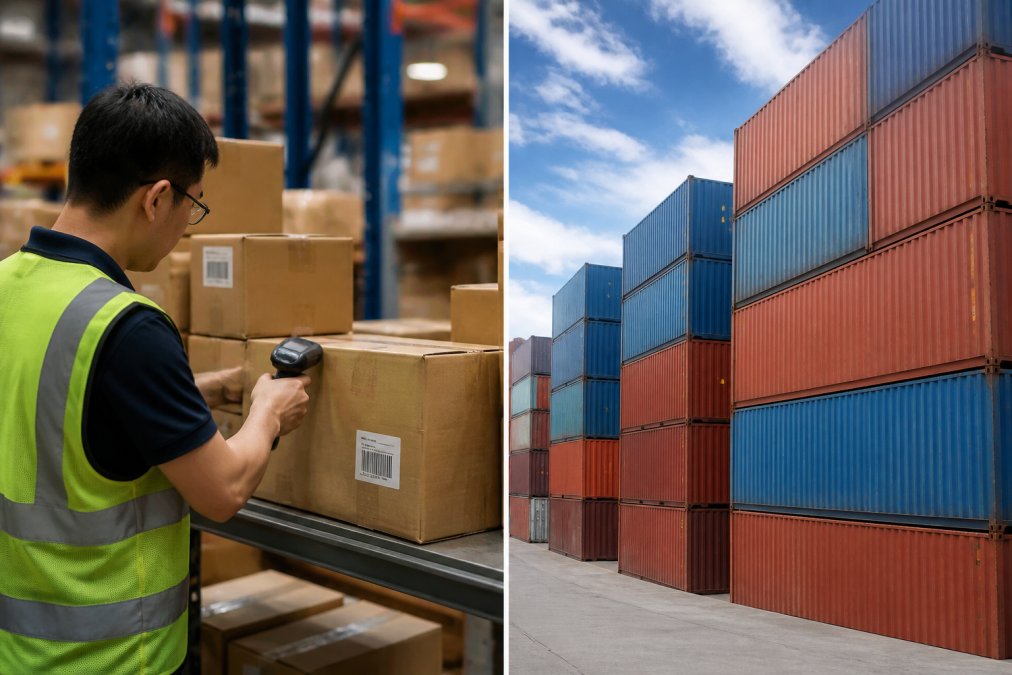
Key requirements include correct shipping label format with scannable barcode, uniform-sized cartons properly sealed and weight-labeled, commercial invoice and packing list that match exactly, on-time delivery to the designated fulfillment center, and compliance with Amazon's safety and quality standards.
Not every freight forwarder understands these requirements. The best forwarders for Amazon FBA have specific experience with Amazon's process and can guide you through labeling, documentation, and delivery timing. According to Amazon's FBA shipping requirements documentation, shipments that arrive damaged or with incorrect documentation face rejection and restocking fees.
Ocean vs. Air Freight for E-Commerce: When to Use Each
The choice between ocean and air freight depends on cost, speed, and product characteristics.
Ocean freight is the default for e-commerce. It costs $1,500-$3,500 per 20-foot container from Asia to the US depending on route and season, with 2-4 week transit time. Ocean freight makes sense for bulk inventory orders, non-urgent replenishment, heavy or bulky products, and seasonal inventory. The tradeoff: you need accurate demand forecasting.
Air freight is expensive but fast, 3-7 day transit time at 4-6 times the cost of ocean freight per unit weight. For high-value, low-weight products or time-sensitive inventory, the speed justifies the premium.
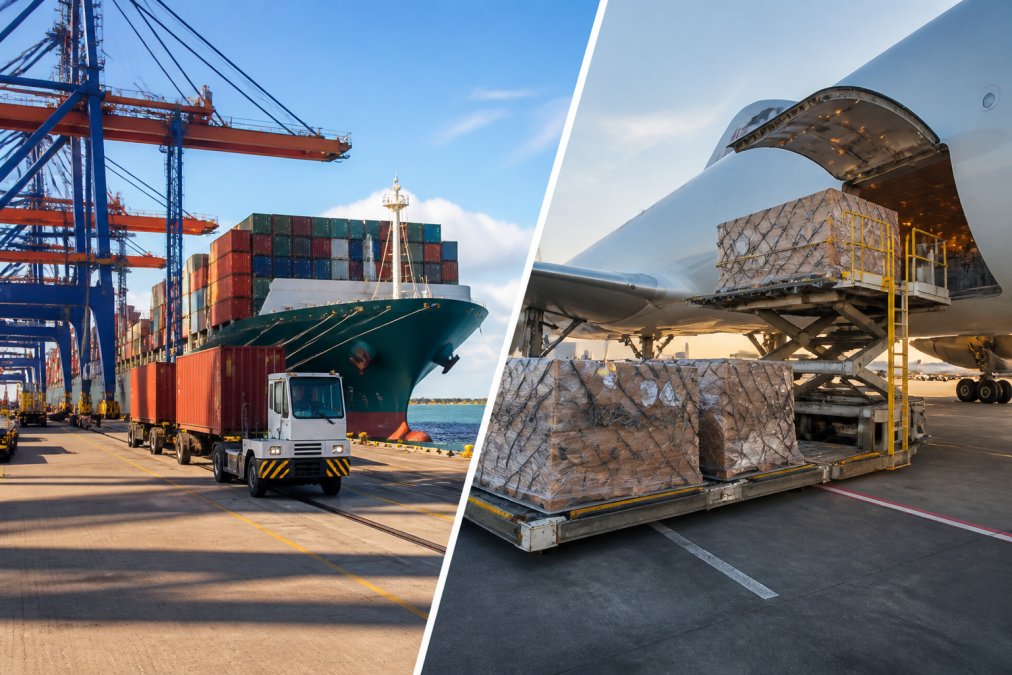
The best strategy for most e-commerce businesses: use ocean freight for baseline inventory and air freight for gap-filling. Plan major inventory orders 8-12 weeks in advance via ocean. Use air freight strategically when demand spikes or you miscalculate. Real-time tracking becomes critical, if your ocean shipment delays, you need to know immediately to decide whether to air freight emergency stock.
How to Evaluate and Select the Right Freight Forwarder
Start with your shipping volume and patterns. How many shipments per month? What's your average weight and CBM?
Then evaluate against these criteria:
Pricing Transparency: Request a detailed landed cost breakdown for a shipment matching your typical volume. A good forwarder itemizes every charge.
Platform Integration: Does the forwarder integrate with your e-commerce platform or ERP? Can they provide API access?
Real-Time Tracking: Can you track shipments in real time? Do you get proactive notifications about delays?
Customs Expertise: Do they have in-house brokerage or outsource? In-house is faster and more reliable.
Scalability: Can the forwarder handle your growth without major service disruptions?
Customer Support: Can you reach someone when there's a problem? What's their response time?
References: Ask for client references in your industry. Talk to at least two current customers about their experience.
The right freight forwarder for e-commerce becomes a strategic partner, not a vendor. You're looking for someone who understands your business, communicates proactively, and delivers predictable results.
Selecting the best freight forwarder for e-commerce requires balancing cost, speed, and reliability. The right choice depends on your shipment volume, product type, and growth trajectory. Freight-Calculator.com delivers instant, transparent international shipping rates with full landed cost visibility, making it ideal for e-commerce businesses that need quick quotes without registration or hidden fees. With 35 years of logistics expertise and licensed forwarder credentials, the platform provides the accountability and data privacy that growing online retailers demand.
Frequently Asked Questions
What should I look for when choosing a freight forwarder for e-commerce?
Prioritize transparency in pricing (no hidden surcharges), real-time tracking across your entire supply chain, and seamless integration with your e-commerce platform. Verify the forwarder is licensed and bonded, offers both ocean and air freight options, and provides clear documentation for customs compliance. Check their experience with LCL and FCL shipments at your typical volume level, and confirm they handle last-mile delivery coordination or have reliable partnerships to complete the journey to your customers.
What is the difference between a 3PL and a freight forwarder for e-commerce?
A 3PL (third-party logistics provider) manages your entire fulfillment operation, including warehousing, inventory management, order picking, and packing. A freight forwarder specializes in moving goods across borders and arranging transportation via ocean, air, or ground. For e-commerce, you may use both: a 3PL for domestic fulfillment and a freight forwarder for international shipments. Some providers offer both services, but their core expertise differs significantly.
How much do freight forwarding services cost for small businesses?
Freight forwarding costs depend on shipment weight, dimensions (CBM), destination, transit time urgency, and whether you book LCL (Less than Container Load) or FCL (Full Container Load). Small businesses typically pay per-shipment rates that vary by season and demand. Fuel surcharges, customs brokerage fees, and documentation charges add to the base rate. Request instant quotes from multiple forwarders to compare landed costs, the total price including all fees from origin to final delivery.
Do I need a freight forwarder for international e-commerce shipping?
Yes, if you ship internationally in volumes beyond standard parcel services. Freight forwarders negotiate better rates with carriers, handle customs clearance and compliance documentation, arrange door-to-door delivery, and provide supply chain visibility. They're essential for LCL and FCL shipments, consolidation opportunities, and managing tariffs and import duties. For small quantities, parcel services may be cheaper, but freight forwarders become cost-effective and necessary as your international order volume grows.
What are the common risks when using a freight forwarder?
Hidden fees that inflate final costs beyond quoted rates, poor communication leading to missed delivery windows or damaged cargo, lack of real-time tracking causing supply chain blind spots, and inadequate customs documentation causing delays or penalties. Mitigate these risks by choosing a licensed, bonded forwarder with transparent pricing, verifying cargo insurance coverage, requesting written confirmation of all fees upfront, and using a platform offering real-time visibility and direct accountability from quote through delivery.
This article was written using GrandRanker