 How-to
How Much Are RoRo Car Shipping Rates?
Last Updated: November 7, 2026
Quick Summary
RoRo car shipping rates typically run about $900 to $2,000 per standard running vehicle on common international lanes, with a separate 2026 comparison putting the range at roughly $950 to $1,800 per running vehicle. Those figures cover port-to-port ocean freight only, so import taxes, destination fees, and inland transport are added on top.
- Published RoRo ranges usually cover port-to-port ocean freight only, not the full landed cost.
- A complete quote has five layers: origin handling, ocean freight, destination fees, customs and duties, and inland transport.
- Destination fees and import taxes are typically excluded from advertised rates and billed separately.
- RoRo wins on cost for standard running vehicles on busy lanes; container suits non-runners and classics.
- Quotes carry short validity periods, so an expired quote is an estimate rather than a price.
Table of Contents
- What RoRo Car Shipping Rates Actually Cost in 2026
- The Full Cost Breakdown Behind a RoRo Car Shipping Quote
- What Moves the Number: Size, Route, Season, and Condition
- RoRo Shipping Rates by Route: What Changes Port to Port
- RoRo vs. Container Shipping Cost: Which Fits Your Vehicle
- Using a RORO Shipping Cost Calculator to Get a Real Number
- Comparing Quotes: A Checklist Before You Book
- Run Your Vehicle Details Through the Calculator
- Frequently Asked Questions
What RoRo Car Shipping Rates Actually Cost in 2026
RoRo car shipping rates typically run about $900 to $2,000 per standard running vehicle on common international lanes, according to A1 Auto Transport's published port-to-port pricing.
Below, we break down what those ranges include, what they leave out, and how to compare two quotes.
Where the Published Ranges Come From
Most published figures describe port-to-port ocean freight only. That means the vessel space, the loading and discharge, and nothing else.
A 2026 comparison from AB Group Shipping estimates RoRo at approximately $950 to $1,800 per running vehicle and notes the figures exclude import taxes and other charges. Broader provider estimates spread wider still, from $500 to $2,400 per car, depending on route, vehicle, and service level.
Why Two Quotes for the Same Car Can Differ by Hundreds
- Scope. One quote is port-to-port; the other includes inland pickup and delivery.
- Port pair. Los Angeles to Rotterdam is not the same cost as Jacksonville to San Juan.
- Timing. Sailing frequency and space availability shift week to week.
The Full Cost Breakdown Behind a RoRo Car Shipping Quote
A complete RoRo car shipping quote has five layers, and most published ranges only cover the middle one. The table below shows the layers, what each one covers, and how it is usually calculated so you can estimate a landed cost instead of a headline rate.
| Cost Layer | What It Covers | How It Is Usually Calculated | Usually in the Advertised Rate? |
|---|---|---|---|
| Origin handling | Terminal receiving, vehicle inspection, stevedoring | Flat per-vehicle terminal fee, sometimes plus a documentation charge | Sometimes |
| Ocean freight | Vessel space, loading, discharge | Per cubic meter or per vehicle, set by the carrier's tariff for the port pair | Yes |
| Destination fees | Port charges, terminal handling, release fees | Flat per-vehicle fee set by the destination terminal, billed in local currency | Rarely |
| Customs and duties | Import taxes, tariffs, clearance brokerage | Percentage of declared value plus a brokerage fee | No |
| Inland transport | Trucking to and from the ports | Per mile or per lane, quoted separately by a trucker | No |
How to Estimate a Landed Cost Before You Book
Start with the ocean freight figure and add each layer in order. Origin handling and destination fees are usually flat per-vehicle amounts, easy to add once disclosed. Customs and duties are hardest to estimate because they depend on declared value, vehicle origin, and the destination country's tariff schedule.
Ocean freight is one layer of a complete quote, so a quote showing only the ocean rate can look cheaper than a complete quote for the same sailing.
Charges That Show Up After the Ocean Rate
Destination-side costs are where budgets go sideways. WCS notes that overseas port charges and destination fees may be additional, and AB Group Shipping explicitly excludes import taxes from its quoted prices.
Ask every provider for a destination fee schedule in writing. If they cannot produce one, treat the quote as incomplete.
Watch out: a quote that bundles destination fees into a single "port charges" line without itemizing them is the most common way a landed cost estimate ends up short.
The Customs and Duties Layer
Import duties and taxes are set by the destination country, not the shipping line, and assessed on the vehicle's declared value. This layer is often the largest single addition to the ocean rate on a typical passenger car.
Before booking, confirm three things: who files the customs entry, what value will be declared, and whether the brokerage fee is included or billed separately. Those answers determine whether the customs layer is a known number or an open-ended one.
Inland Transport and Delivery
Inland trucking is quoted per lane and per vehicle, and is almost never included in a port-to-port RoRo rate. For door-to-door service, ask for the inland leg as a separate line so you can see what the port-to-port portion actually costs.
Add the five layers together for a landed cost estimate. Compare quotes on that total, not the ocean rate alone, and the cheapest headline number often stops being the cheapest shipment.
What Moves the Number: Size, Route, Season, and Condition
Four variables explain most of the variation in RoRo car shipping rates: vehicle dimensions, route, booking timing, and whether the vehicle runs.
Vehicle Dimensions and Weight
RoRo pricing is built on cubic space, not just length. A compact sedan occupies far less deck space than a full-size pickup or SUV.
Oversize vehicles, lifted trucks, and anything that cannot clear the ramp under its own power get surcharged or rejected. Measure height with roof racks and accessories removed.
Condition Rules That Decide Eligibility
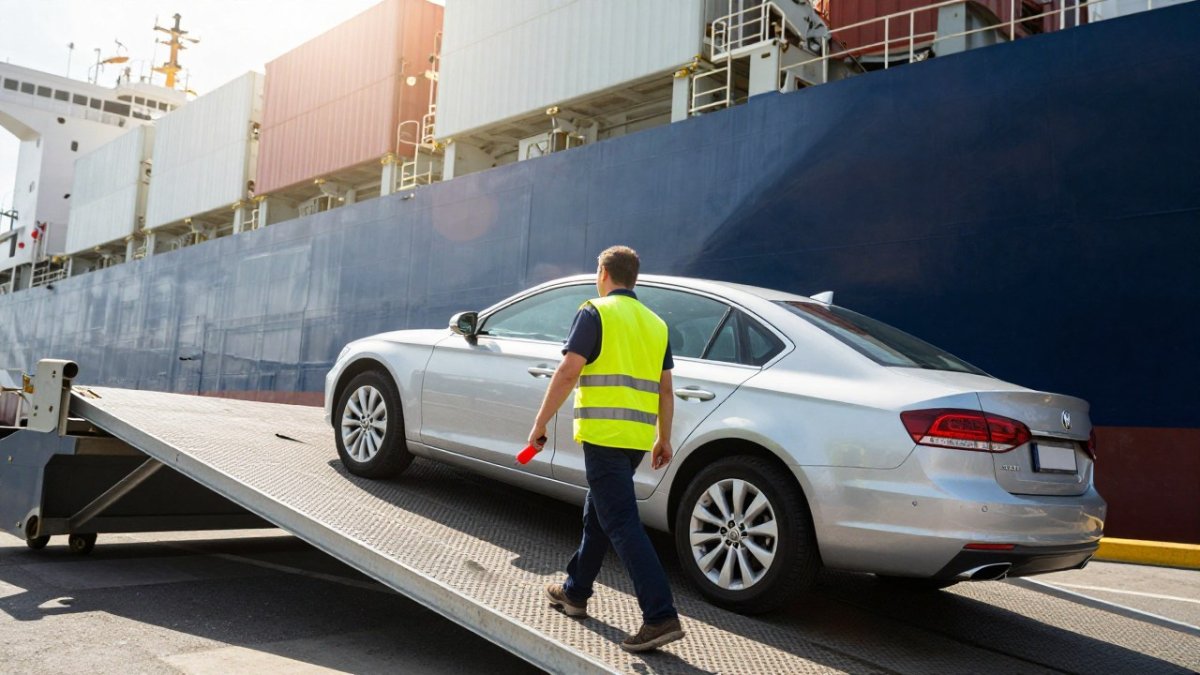
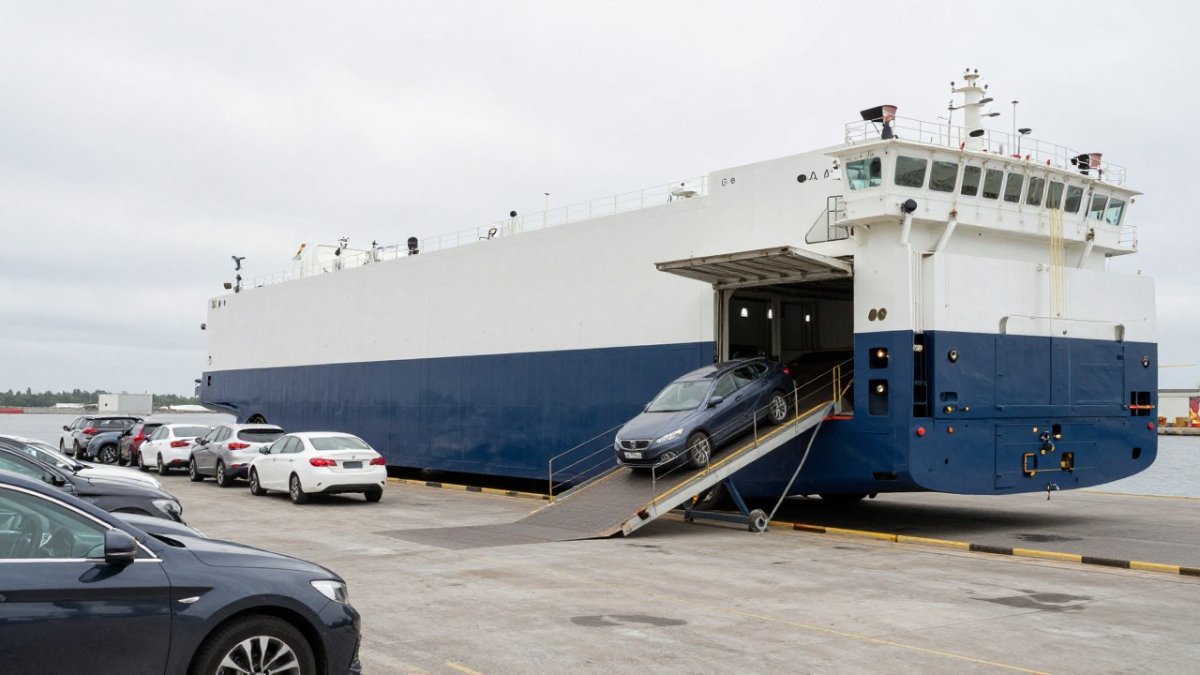
Running vehicles drive on and off under their own power. That is the baseline RoRo requirement.
Non-running, classic, high-value, and salvage vehicles are often better served by container shipping, which AB Group Shipping says suits non-running or classic cars. If you are shipping trucks, machinery, or titled vehicles with different eligibility rules, our truck and machinery export page covers how RoRo and container options apply.
RoRo Shipping Rates by Route: What Changes Port to Port
Route is the single biggest lever on RoRo shipping rates by route, working through distance, sailing frequency, and port congestion. Look at how rates differ across lane types, then check your own lane against a dated quote rather than a published range.
How Lane Type Changes the Rate
High-volume lanes with frequent sailings spread fixed costs across more vehicles. Thin lanes with monthly service carry the same fixed costs on fewer units, so each car pays more.
Port pairs matter too. A congested destination terminal adds handling time and fees that a quieter port does not. Vehicle-carrier capacity is also tightening: a TGA Logistics report citing Clarksons data notes roughly 31 car carriers ordered so far in 2026, which tells you space will stay competitive on the busiest lanes.
Reading a Route-Specific Rate Example
Published ranges are useful only when you know what they assume. When you look at a route-specific example, check five assumptions before comparing it to your own shipment:
- The port pair, named specifically rather than by region
- The vehicle class and approximate dimensions
- Whether the rate is port-to-port or door-to-door
A rate example that does not state those five assumptions is not comparable to your shipment, even if the number looks close. Ask the provider to restate it on your port pair and vehicle class before budgeting.
Rate Volatility and Booking Timing
RoRo rates move with fuel, vessel capacity, seasonality, and sailing frequency. Quotes usually carry a validity period measured in days rather than months, because carriers adjust tariffs and bunker surcharges on short notice; an expired quote is an estimate, not a price.
Request quotes for two or three sailing windows and compare them on the same terms. A materially lower later rate usually reflects capacity and seasonality, not a better carrier; a materially higher one means the lane is tight and you should confirm space early.
Watch out: a quote with no stated validity period and no named sailing window cannot be compared to a second quote, because you do not know what each one is pricing.
Comparing RoRo Against Other Modes on Your Lane
Before committing to a sailing, price the same vehicle on the same port pair in a container to see whether RoRo is actually the lower option. On busy lanes with standard running vehicles, RoRo usually wins on cost.
If you want to compare RoRo against container and other freight modes before committing, our international freight shipping services page lays out the options side by side.
RoRo vs. Container Shipping Cost: Which Fits Your Vehicle
RoRo wins on cost for standard running vehicles on busy lanes.
A 2025 study in Transportation Research Part B examined maritime vehicle transport planning across both RoRo and container modes, which reflects the reality: the two are complements, not substitutes.
Exclusive container bookings can cost more per vehicle than RoRo, while shared container loading may narrow that gap for smaller vehicles.
Using a RORO Shipping Cost Calculator to Get a Real Number
A RORO shipping cost calculator turns vehicle details and a port pair into an actual rate instead of a range, the fastest way to see whether a published figure applies to your car.
You will need four inputs ready:
- Vehicle make, model, and year
- Overall dimensions and running condition
- Departure and destination ports
Our RORO shipping calculator takes those details and returns a rate in seconds, with no registration required. As a licensed and bonded NVOCC rather than a marketplace, Freight-Calculator.com provides rates from its own forwarding operations.
Comparing Quotes: A Checklist Before You Book
Two quotes are only comparable if they cover the same scope. Run every quote through this checklist before you commit.
- Does the rate state port-to-port or door-to-door?
- Are origin terminal handling charges itemized?
- Is a destination fee schedule attached in writing?
Watch out: a quote with no expiry date and no destination fee schedule is not a quote, it is an estimate. Budget for it to grow.
To compare ocean, air, RoRo, and container numbers side by side, our shipping rate calculator handles all four in one place. For the broader picture on methods and costs, the international car shipping guide is the place to start.
Run Your Vehicle Details Through the Calculator
The published ranges are a starting point, not a price. Your actual RoRo car shipping rate depends on your vehicle, port pair, and sailing window.
At Freight-Calculator.com, the platform is designed to give you an instant rate in under 30 seconds, with no registration required.
Get started with Freight-Calculator.com and price your vehicle before you commit to a sailing.
Frequently Asked Questions
How much does it cost to ship a car via RoRo?
Published provider estimates vary widely by route and service level, and they typically cover port-to-port ocean freight for a standard running car. Those figures cover the ocean leg only. Import taxes, destination port charges, and inland delivery sit outside that number, so the amount you actually pay at the end is usually higher than the advertised rate.
Is RoRo cheaper than container shipping?
For a standard running car, RoRo usually comes in lower because you pay for space on a shared vessel deck rather than a whole box. The gap narrows once you factor in container loading, lashing, and drayage. Containers win on protection and flexibility: they suit non-running, classic, high-value, and salvage vehicles that RoRo terminals may refuse. Compare both against your specific vehicle condition before deciding which is cheaper in practice.
What costs are included in a RoRo car shipping quote?
A quote should separate the ocean freight from everything else. Expect line items for terminal handling at the departure port, port charges at destination, documentation, and any inland transport on either end. Import duties and taxes are almost always excluded. Ask each provider to confirm in writing which fees are prepaid and which are collected at the destination port, because that is where surprise invoices come from.
Can I ship a non-running car using RoRo?
Most RoRo terminals require the vehicle to drive on and off under its own power, so a non-runner is usually turned away. Container shipping is the standard workaround: a car can be winched into a shared or exclusive container without needing to start. If your vehicle is a non-runner, a classic, or a salvage unit, price a container option alongside any RoRo quote before you commit to a booking.