 how-to
International Cargo Volume Planning Tips
Table of Contents
- How to Calculate CBM for Shipping Containers
- Chargeable Weight vs Gross Weight in International Shipping
- How to Optimize Container Load Efficiency
- International Shipping Documentation Requirements
- Booking and Lead Time Planning for Cargo Volume
- Using Technology to Track and Optimize Cargo Volume
- Conclusion
Last Updated: August 21, 2026
How to Calculate CBM for Shipping Containers
Cubic meters, or CBM, determine how much physical space your cargo occupies in a shipping container. This measurement is fundamental to international cargo volume planning because it directly affects your shipping costs, container selection, and overall logistics efficiency.
Understanding CBM matters because freight charges are calculated based on whichever is greater: actual weight or volumetric weight. A light but bulky shipment might cost more to ship than a heavy, compact one. This is where accurate CBM calculations become critical to avoiding surprise fees and optimizing your freight spend.
Understanding Cubic Meters and Why They Matter
A cubic meter equals 1,000 liters or 35.3 cubic feet. In shipping, CBM represents the three-dimensional space your cargo consumes. When you're planning international cargo volume, you need to know this number before booking space with a carrier.
According to FreightAmigo's 2026 International Freight Trends report, sea freight continues to dominate international freight services by volume (80-90%), while air freight leads in value (35%) (freightamigo.com). This distinction matters because ocean containers have fixed dimensions, while air freight charges are heavily influenced by volumetric weight calculations.
The reason CBM matters in cargo volume planning is simple: carriers need to know whether your shipment will fit their equipment and how much space it will consume relative to other cargo. A 20-foot container holds approximately 33 CBM, while a 40-foot container holds roughly 67 CBM. If your cargo exceeds these limits, you'll need additional containers or different equipment entirely.
Step-by-Step CBM Calculation Formula
The CBM formula is straightforward: Length (meters) × Width (meters) × Height (meters) = CBM.
Here's how to apply it to a real shipment:
- Measure your cargo's length, width, and height in meters (convert inches to meters by dividing by 39.37)
- Multiply all three dimensions together
- Round up to the nearest 0.001 CBM
- If you have multiple boxes or pallets, calculate CBM for each unit separately, then add them together
Example: You're shipping a pallet measuring 1.2 meters long, 1.0 meter wide, and 1.5 meters high.
- 1.2 × 1.0 × 1.5 = 1.8 CBM
If you're shipping 10 identical pallets, multiply: 1.8 × 10 = 18 CBM total.
For irregular shapes (cylinders, bags, oddly-stacked items), measure the smallest rectangular box that would contain the item, then calculate based on that box. This prevents underestimating your actual space needs during shipment.
Chargeable Weight vs Gross Weight in International Shipping
Your shipment's cost is determined by the greater of two weights: actual gross weight or chargeable weight (also called volumetric weight). Understanding this distinction prevents unexpected charges and helps you optimize your cargo volume planning strategy.
Gross weight is simply what your cargo weighs on a scale. Chargeable weight is calculated using the formula: CBM × 167 kilograms per CBM for ocean freight, or CBM × 6 kilograms per CBM for air freight. The difference reflects the density requirements of each transport mode.
When Volumetric Weight Takes Priority
Volumetric weight matters most when you're shipping lightweight, bulky items. A shipment of pillows, cushions, or packaging materials might weigh only 500 kilograms but occupy 4 CBM. Using the ocean freight density: 4 × 167 = 668 kilograms chargeable weight. You'd pay for 668 kilograms even though the actual weight is only 500 kilograms.
This is where international cargo volume planning becomes strategic. If your shipment's volumetric weight exceeds its gross weight, you have options: consolidate with other shipments to improve density, reduce packaging materials, or switch to a different transport mode.
According to UPS Supply Chain Solutions' 2026 Q3 Global Freight Transportation report, global air cargo demand grew 12.6% year-over-year in Q2 2026, while air cargo capacity grew 7.8%. This capacity tightness means volumetric weight calculations are more critical than ever, carriers have less flexibility to absorb low-density shipments at standard rates.
For air freight, the impact is even more dramatic. Using 6 kilograms per CBM: a 2 CBM shipment weighing 5 kilograms would be charged as 12 kilograms (iata.org). Air freight's higher density requirement reflects the limited cargo space on aircraft compared to ocean vessels.
How to Optimize Container Load Efficiency
Container load optimization is where cargo volume planning directly impacts your bottom line. The goal is to maximize the use of available container space while respecting weight limits and product compatibility. Most shippers achieve 60-75% use on their first attempt. With deliberate optimization, 80-85% is realistic.

Palletization and Space use Strategies
Standard pallets in North America measure 1.2 meters × 1.0 meter (48 inches × 40 inches). A 40-foot container can hold 24-26 standard pallets depending on how they're stacked and oriented. Knowing this baseline helps you plan shipments efficiently.
The key to optimization is understanding how your products stack. A product that's 1.0 meter × 1.0 meter × 1.2 meters high can be stacked 2 units high in a 2.4-meter-tall container (accounting for pallet height). This simple calculation determines whether you can fit 24 or 48 units in a single container.
Orientation matters significantly. A pallet loaded lengthwise (1.2 meters along the container length) uses space differently than one loaded widthwise (1.0 meter along the length). Test both orientations when planning your load. Sometimes rotating pallets by 90 degrees creates space for additional units or improves weight distribution.
Packaging Best Practices for Air Freight
Air freight requires different packaging considerations than ocean freight. Your packaging must protect cargo during pressure changes, temperature fluctuations, and rapid handling. Equally important, packaging should minimize dimensional weight.
Use corrugated fiberboard boxes rather than rigid plastic containers when possible. Cardboard is lighter and compresses slightly, improving density. Avoid excessive internal padding, use void fill only where necessary to prevent product movement.
For air freight, shrink-wrap pallets tightly to reduce exposed dimensions. A loosely wrapped pallet might measure 1.3 meters × 1.1 meters due to protruding edges, while the same products wrapped tightly measure 1.2 meters × 1.0 meter. That small reduction compounds across multiple pallets.
Stack products directly on pallets without additional packaging layers when feasible. Each layer of packaging material adds weight and volume without adding product value. If you're shipping 20 identical boxes, consider whether you could ship them as a single pallet load rather than individual packaged units.
International Shipping Documentation Requirements
Documentation is where many shippers encounter delays and unexpected costs. Missing or incorrect paperwork can hold your shipment in customs for days, triggering storage fees and delivery delays. Proper documentation is non-negotiable for international cargo volume planning.
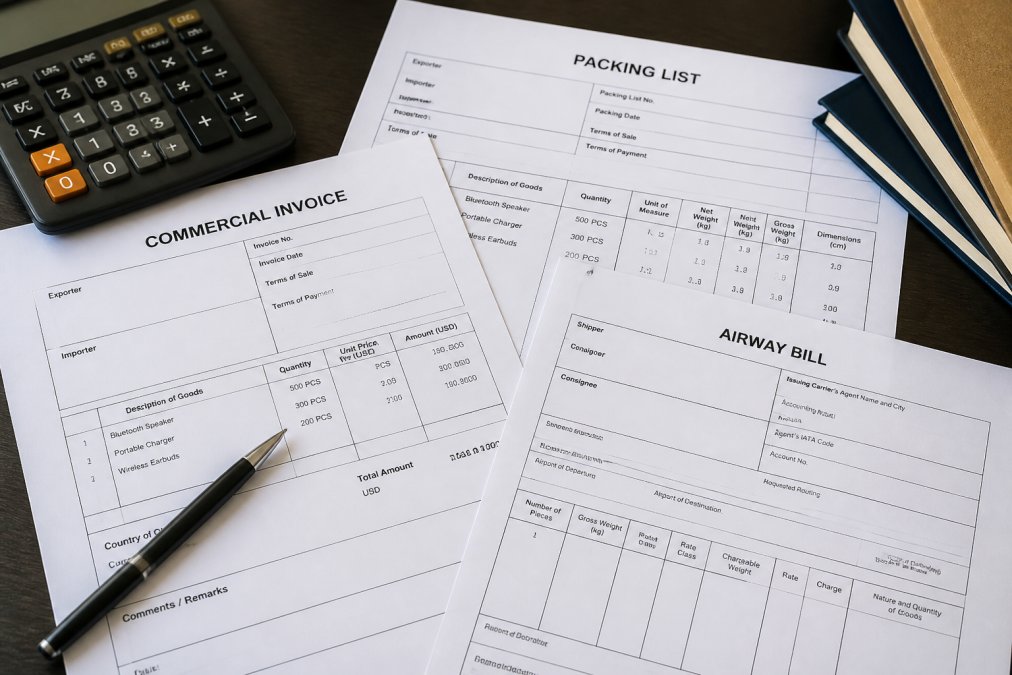
The documentation package typically includes a commercial invoice, packing list, bill of lading (for ocean freight) or airway bill (for air freight), and potentially certificates of origin or inspection documents depending on the product type and destination.
Commercial Invoice and Packing List Essentials
Your commercial invoice must include: shipper and consignee details, itemized product descriptions, quantities, unit prices, total value, currency, incoterms, and payment terms. Customs officials use this document to assess duties and verify the shipment's legitimacy.
The packing list serves a different purpose, it maps which products are in which boxes or pallets. This document is critical for warehouse receiving and inventory verification. It should include box numbers, contents of each box, weights, and dimensions. When your customer receives the shipment, they'll use the packing list to verify they received everything.
Accuracy matters because discrepancies between the invoice and packing list trigger customs inspections. If your invoice lists 100 units but the packing list shows 98 units, customs will hold the shipment pending clarification. This delay costs money and damages customer relationships.
Frederick W. Smith, Founder and CEO at FedEx, noted that "The information about package is as important as the delivery of the package itself." This principle applies directly to international documentation, the paperwork determines whether your cargo moves smoothly or gets held at the border.
Shipment Labeling and Marking Standards
Every box or pallet must be clearly labeled with the destination address, shipper information, and handling instructions. For international shipments, include the country of origin and harmonized tariff code (HS code) on the label or attached documentation.
Use durable labels that won't smudge or fade during transit. Shipping manifest barcodes should be scannable throughout the journey. Include language-appropriate handling marks like "FRAGILE," "THIS SIDE UP," or "KEEP DRY" if applicable.
For air freight specifically, hazardous material labels (if applicable) must be prominently displayed. Even if your product isn't classified as hazardous, ensure all labels comply with International Air Transport Association (IATA) standards. Incorrect labeling can result in shipment rejection or rerouting.
Booking and Lead Time Planning for Cargo Volume
Lead time planning directly impacts your ability to consolidate shipments and optimize costs. A shipment booked with 7 days' notice allows time to consolidate with other cargo. A shipment booked with 24 hours' notice must move on the next available departure, regardless of container use.
Most ocean freight carriers require 3-5 days' advance notice for container bookings. Air freight carriers typically require 24-48 hours. If you're planning international cargo volume, factor these lead times into your procurement and fulfillment schedules.
Global container trade reached a historic record of 192.9 million TEU in 2025, a 4.7% increase, according to Maritime Analytica's 2026 analysis (maritimeanalytica.com). Despite this volume growth, pricing power isn't rising, demand is rising, but freight rates remain competitive. This environment rewards shippers who plan ahead and consolidate shipments.
Booking space in advance also improves shipping feasibility for less common routes. If you're shipping to a smaller port or less-traveled lane, advance booking ensures space availability. Last-minute bookings on these routes may not be possible, forcing you to use alternative routing that costs more.
Create a booking calendar that aligns with your sales forecasts. If you expect peak demand in September, start booking space in July. This advance notice gives you flexibility to consolidate shipments, negotiate better rates, and ensure reliable transit times.
Using Technology to Track and Optimize Cargo Volume
Technology transforms cargo volume planning from a manual, error-prone process into a data-driven operation. Freight-Calculator.com's integrated CBM calculator eliminates manual measurement errors and provides instant visibility into volumetric requirements before you commit to booking space.
Real-time tracking systems provide supply chain visibility throughout transit. You can monitor container status, vessel location, and estimated arrival times from a single interface. This visibility enables better inventory planning at your destination and reduces uncertainty about delivery dates.
API integration with your e-commerce platform or inventory system automates the cargo volume calculation process. When an order is placed, the system automatically calculates CBM based on product dimensions and weight. This automation prevents booking errors and ensures consistent cargo volume planning across all shipments.
Post-shipment analytics reveal patterns in your shipping behavior. Analyzing historical data shows which routes, carriers, and consolidation strategies deliver the best cost-efficiency. These insights inform future cargo volume planning decisions.
According to Cleo's 2026 logistics trends report, demands for real-time data and supply chain transparency for critical collaborations are major logistics trends shaping management in 2026. Shippers that embrace technology-driven cargo volume planning gain competitive advantages through faster decision-making and lower operational costs.
== FAQ ANSWERS (audit these too, same rules) ===
[1] Q: How do you calculate cargo volume for international shipping? A: Cargo volume is calculated in cubic meters (CBM) using the formula: length (meters) × width (meters) × height (meters). For example, a box measuring 1m × 1m × 1m equals 1 CBM. Most international freight pricing depends on either the actual weight or volumetric weight, whichever is greater. Tools like Freight-Calculator.com include an integrated CBM calculator to determine your shipment's volume instantly without manual calculations.
[2] Q: What is the difference between chargeable weight and gross weight in air freight? A: Gross weight is the actual weight of your cargo plus packaging. Chargeable weight is determined by comparing gross weight to volumetric weight, whichever is greater. For air freight, volumetric weight often exceeds gross weight because carriers charge based on space occupied. If your 100 kg shipment has a volumetric weight of 150 kg, you pay for 150 kg. This is why accurate CBM calculations directly impact your freight costs.
[3] Q: How can I maximize container space for international freight? A: Maximize space through strategic palletization, using corrugated fiberboard dividers, and applying shrink-wrap to secure items. Stack items by weight and fragility, not randomly. Calculate cargo density before booking to identify underutilized space. Planning shipments with realistic lead times allows you to consolidate smaller orders into fuller containers, improving cost-efficiency.
[4] Q: What documentation is required for international cargo planning? A: Essential documents include a commercial invoice, packing list, airway bill (for air freight), and shipping manifest. The commercial invoice must detail product descriptions, quantities, values, and harmonized tariff codes for customs clearance. Your packing list should match invoice line items exactly. Proper shipment labeling with weight, dimensions, and handling instructions ensures regulatory compliance and delivery accuracy. Missing or incorrect documentation delays customs clearance and increases transit time.
Frequently Asked Questions
Q: How do you calculate cargo volume for international shipping?
A: Cargo volume is calculated in cubic meters (CBM) using the formula: length (meters) × width (meters) × height (meters). For example, a box measuring 1m × 1m × 1m equals 1 CBM. Most international freight pricing depends on either the actual weight or volumetric weight, whichever is greater. Tools like Freight-Calculator.com include an integrated CBM calculator to determine your shipment's volume instantly without manual calculations.
Q: What is the difference between chargeable weight and gross weight in air freight?
A: Gross weight is the actual weight of your cargo plus packaging. Chargeable weight is determined by comparing gross weight to volumetric weight, whichever is greater. For air freight, volumetric weight often exceeds gross weight because carriers charge based on space occupied. If your 100 kg shipment has a volumetric weight of 150 kg, you pay for 150 kg. This is why accurate CBM calculations directly impact your freight costs.
Q: How can I maximize container space for international freight?
A: Maximize space through strategic palletization, using corrugated fiberboard dividers, and applying shrink-wrap to secure items. Stack items by weight and fragility, not randomly. Calculate cargo density before booking to identify underutilized space. Planning shipments with realistic lead times allows you to consolidate smaller orders into fuller containers, improving cost-efficiency.
Q: What documentation is required for international cargo planning?
A: Essential documents include a commercial invoice, packing list, airway bill (for air freight), and shipping manifest. The commercial invoice must detail product descriptions, quantities, values, and harmonized tariff codes for customs clearance. Your packing list should match invoice line items exactly. Proper shipment labeling with weight, dimensions, and handling instructions ensures regulatory compliance and delivery accuracy. Missing or incorrect documentation delays customs clearance and increases transit time.
International cargo volume planning doesn't have to be complicated. Accurate CBM calculations, understanding chargeable weight, and strategic container optimization are the fundamentals. Freight-Calculator.com's registration-free platform provides instant international shipping rates with integrated CBM calculations, eliminating guesswork from your cargo volume planning. Get a transparent quote in under 30 seconds and see exactly how your shipment dimensions and weight affect your landed costs.
This article was written using GrandRanker