 how-to
How to Avoid Hidden Freight Fees: A Shipper's Guide
Table of Contents
- Understanding Common Accessorial Fees
- How to Read a Freight Invoice and Spot Unexpected Charges
- How to Audit Freight Invoices for Hidden Fees
- Freight Contract Negotiation Tips to Lock in Transparent Pricing
- Proactive Planning Strategies to Avoid Hidden Freight Fees
- Dispute Resolution Workflows for Unexpected Charges
- Conclusion
Last Updated: August 13, 2026
Understanding Common Accessorial Fees
Hidden freight fees account for 15-30% of total landed costs when left unmanaged. Accessorial fees are charges applied beyond the base freight rate for services, equipment, handling, or delays outside standard door-to-door pickup and delivery. The danger lies in their invisibility, carriers often don't itemize them clearly in initial quotes, leaving you to discover liftgate service, inside delivery, and detention charges only at invoice time.
Demurrage and Detention Charges
Demurrage is the charge for keeping a container at a port beyond the free time allowed; detention applies to containers held off-port at your facility or warehouse. Free time typically ranges from 3 to 7 days depending on the carrier and port, but it's not standardized. A container held for 14 days instead of 7 can easily add hundreds of dollars. Without explicit clarification in your contract, you're gambling on what you'll actually owe.
Detention charges apply to the container itself, not just contents. If your warehouse is slow to unload or customs delays clearance, the clock keeps running. International shipments are especially vulnerable because customs clearance can take days while you're paying detention the entire time.
Fuel Surcharges, Liftgate Services, and Residential Delivery
Fuel surcharges fluctuate based on crude oil prices and are applied as a percentage of the base freight rate. A 5% fuel surcharge on a $2,000 shipment adds $100 to your cost.
Liftgate service uses a hydraulic lift to lower freight to ground level. If your facility lacks a loading dock, you'll need this service, a common surprise charge many shippers don't realize they need until the truck arrives.
Residential delivery adds extra cost because it requires more care and navigating narrower streets and driveways, ranging from $50 to $300 depending on location and carrier. Inside delivery, where the carrier brings freight inside your building rather than leaving it at the curb, requires additional labor and can add $200-500 to a single shipment.
How to Read a Freight Invoice and Spot Unexpected Charges
A freight invoice contains far more than the base freight cost. Start with the header section to verify the bill of lading number, shipment date, delivery date, and parties involved. Confirm that pickup and delivery addresses match your original order.
Examine the freight description for commodity, weight, dimensions, and freight class. Freight class determines the base rate, if your shipment was quoted at class 85 but invoiced at class 100, you'll pay more.
For less-than-truckload (LTL) shipments, verify dimensional weight: length × width × height ÷ 166 = dimensional weight. If this calculation appears on your invoice, confirm it matches your shipment's actual dimensions.
The charges section is where hidden freight fees hide. Look for line items beyond base freight: fuel surcharge, accessorial fees (liftgate, inside delivery, residential delivery), handling charges, detention or demurrage, and administrative fees. Each line item should have a description and rate. Vague charges are red flags.
Verify that the total section itemizes subtotals correctly: base freight, accessorials, fuel surcharge, taxes, and final total. Use a calculator to verify every addition.
How to Audit Freight Invoices for Hidden Fees
Auditing freight invoices catches errors, identifies patterns, and strengthens contract negotiations.
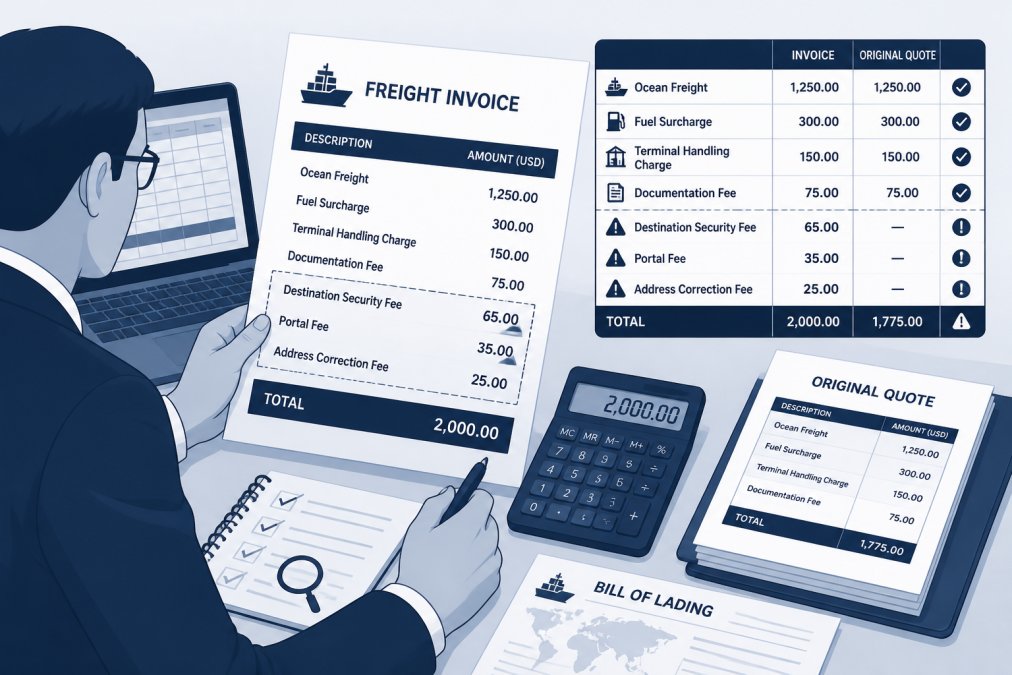
Step-by-Step Audit Process
Step 1: Gather Documentation Collect the original quote, bill of lading, purchase order, and carrier's rate card if available. Compare these documents side by side for any discrepancies.
Step 2: Verify Basic Information Confirm that shipment details match across all documents: pickup and delivery addresses, weight, dimensions, freight class, and service level. A single error can cascade into multiple charges.
Step 3: Calculate Dimensional Weight For LTL shipments, calculate dimensional weight independently: length × width × height ÷ 166. Compare your calculation to the invoice. Some carriers use different divisors (139 instead of 166), which is a variance worth understanding.
Step 4: Itemize All Charges List every charge separately. For each, ask: Was this in the original quote? If not, is there a legitimate reason? Fuel surcharges are standard, but liftgate, inside delivery, and residential delivery should have been disclosed upfront.
Step 5: Cross-Reference the Rate Card Verify that the base freight rate matches the published rate for your lane, weight, and class. A significant variance warrants investigation.
Step 6: Flag Discrepancies and Document Them Create a spreadsheet tracking invoices, charges, and discrepancies. Patterns emerge over time, one carrier might consistently charge for detention on Fridays, or inside delivery fees might always exceed quotes. These patterns give you negotiation leverage.
Common Invoice Reconciliation Mistakes
Comparing only total invoice amount to total quoted amount is dangerous. The invoice could have extra charges offset by a discount, or the quote might have been wrong. Don't ignore small charges, a $50 miscellaneous fee on a $3,000 shipment seems trivial, but multiply that across 100 shipments yearly and you're leaving $5,000 on the table.
Don't question charges that appear on every invoice. If liftgate service is charged on every shipment but wasn't explicitly quoted, that's a recurring hidden fee worth negotiating away. Always document discrepancies in writing, verbal agreements disappear on the next invoice. Finally, compare invoices across carriers for the same lane. If Carrier A charges $2,500 but Carrier B quotes $2,200 for identical service, that $300 difference is real money.
Freight Contract Negotiation Tips to Lock in Transparent Pricing
A well-negotiated freight contract specifies exactly what's included and what costs extra, leaving no room for surprise charges.

What to Ask Your Carrier or Freight Broker
What is included in your base rate? The answer should specify pickup, linehaul, and delivery to a commercial dock. Anything beyond that is an accessorial.
What is your free time policy? Get the exact number of free days for containers at the port and off-port, and how free time is calculated.
What are your standard accessorial charges? Request a written list of all possible charges: liftgate, inside delivery, residential delivery, detention, demurrage, fuel surcharge percentage, and others.
Do you charge for inside delivery at residential addresses? Lock in the rate or negotiate an exemption if you ship to residences.
What is your fuel surcharge formula? Fuel surcharges should be tied to a published index like the Department of Energy crude oil price, not the carrier's own calculation.
What happens if my container is delayed in customs? Clarify whether detention charges apply during customs clearance.
Are there any documentation or administrative fees? These should be disclosed and negotiated.
What is your invoice timeline? Specify invoice issuance within 30 days of delivery to allow time for dispute.
Incoterms Impact on Hidden Fees
Incoterms define who is responsible for freight costs at different stages. Under FOB (Free on Board), the buyer pays ocean freight and is responsible for demurrage and detention after the container reaches the destination port, creating exposure to hidden fees. Under CIF (Cost, Insurance, and Freight), the seller pays all freight to the destination port, shifting demurrage risk to the seller. Under DDP (Delivered Duty Paid), the seller bears all hidden fee risk, which is why DDP pricing is always higher.
Many shippers don't realize that Incoterms determine who negotiates with the carrier. Under FOB, you negotiate directly and control contract terms. Under CIF or DDP, your supplier negotiates with no visibility into terms, making hidden fees more common.
Proactive Planning Strategies to Avoid Hidden Freight Fees
Avoiding hidden freight fees requires planning shipments to minimize exposure to accessorial charges.
Using a Transportation Management System (TMS)
A Transportation Management System automates freight booking, tracks shipments, and flags potential charges before they occur. It calculates dimensional weight, identifies which carriers charge for liftgate service, and estimates total landed cost including accessorials. The real value is visibility, you see in advance that a residential delivery will incur a $150 charge and can compare full cost breakdowns across carriers.
A TMS maintains historical data showing which carriers consistently charge for detention, have the shortest free time, and apply fuel surcharges most aggressively. This data informs future negotiations and carrier selection. Freight-Calculator.com's instant quoting shows the full cost breakdown, including accessorials, in under 30 seconds, helping you understand the true cost of each option.
Small Business vs. Enterprise Approaches
Small businesses with limited volume can still avoid hidden freight fees through smart planning. Negotiate fixed rates for recurring lanes with a single carrier, volume commitment gives you leverage even with modest shipment counts. Consider freight consolidation: combining multiple shipments into one larger shipment often qualifies for better rates and fewer accessorial charges.
Enterprise shippers should implement a TMS, conduct regular auditing, and assign someone to contract management. Using a freight broker or forwarder who specializes in your industry provides relationships with carriers and negotiates volume discounts and transparent pricing across multiple carriers. The broker fee is usually offset by savings from better rates and fewer hidden charges.
Dispute Resolution Workflows for Unexpected Charges
Despite best efforts, unexpected charges still appear. A systematic dispute workflow prevents overpayment and establishes a track record with your carrier.
Step 1: Document the discrepancy. Screenshot the invoice, highlight the disputed charge, and note the discovery date. Include the original quote or contract language that contradicts the charge.
Step 2: Contact the carrier's billing department. Email creates a written record. Reference the specific invoice number, disputed charge, and supporting documentation.
Step 3: Set a deadline. Give the carrier 5-7 business days to respond. Follow up if they don't.
Step 4: Negotiate if necessary. If documentation is ambiguous, offer to split the difference or negotiate a credit on future shipments.
Step 5: Escalate if the carrier refuses. For significant charges, file a complaint with the Federal Maritime Commission (FMC) for international ocean freight or the Surface Transportation Board (STB) for domestic freight.
Step 6: Document the outcome. Record whether the charge was removed, reduced, or stood. Track this in your carrier performance spreadsheet. Patterns of disputed charges should influence your carrier selection.
Avoiding hidden freight fees requires vigilance at three stages: quoting, invoicing, and contract management. Demand transparent quotes that itemize all potential charges. Audit invoices systematically against the original quote and contract. Negotiate contracts that specify exactly what's included and what costs extra.
Freight-Calculator.com helps shippers see the full cost picture upfront by showing all charges, base freight, fuel surcharges, and accessorials, in a single quote. With transparent pricing visible before you commit, you can compare carriers fairly and avoid invoice surprises. Get a quote today and see exactly what your shipment will cost, with no hidden fees.
Frequently Asked Questions
What are the most common hidden freight accessorial fees I should watch for?
The most frequent hidden charges include demurrage (container storage fees), detention (equipment holding charges), fuel surcharges, liftgate services for elevated loading, inside delivery to non-dock locations, and residential delivery premiums. Many shippers also overlook dimensional weight charges, overweight fees, and appointment-based delivery surcharges. Request a complete list of all possible accessorial fees from your carrier or freight broker upfront, and ask which ones apply to your specific shipment profile. This prevents surprises when the invoice arrives.
How can I audit my freight invoices to catch unexpected charges?
Start by comparing the invoice against your original shipping quote and bill of lading. Verify that linehaul charges match your agreement, then cross-check every accessorial fee listed. Confirm delivery dates to ensure you're not charged for demurrage or detention beyond free time allowances. Use a transportation management system (TMS) or spreadsheet to track invoices over time and identify patterns of recurring unexpected fees. If discrepancies exist, document them with supporting shipment records and contact your carrier within 30 days to dispute.
What should I ask my freight broker or carrier to avoid hidden fees?
Request a written breakdown of all potential charges: linehaul, fuel surcharge, accessorial fees, and any volume-based discounts. Ask about free time policies for demurrage and detention, residential delivery rules, and how dimensional weight is calculated for your cargo. Clarify which party (shipper, consignee, or carrier) bears responsibility for each fee type. Get confirmation in writing that the quoted price is all-inclusive except for services you explicitly request. This creates accountability and gives you grounds to dispute unexpected charges later.
How do Incoterms affect hidden freight fees and my cost responsibility?
Incoterms define which party (buyer or seller) pays for shipping, insurance, and customs at each stage. For example, FOB (Free on Board) means the seller covers freight to the port but the buyer pays ocean shipping and import duties. CIF (Cost, Insurance, and Freight) means the seller covers most costs but not import duties. If your Incoterms are unclear, you may be charged for services you thought were included. Review your purchase agreement to confirm Incoterms alignment with your shipping quote, and ask your freight forwarder to specify which costs fall under your responsibility.
This article was written using GrandRanker