 How-to
Container Shipping to Colombia: Costs, Ports, and Booking
Last Updated: November 17, 2026
Quick Summary
Container shipping to Colombia starts with choosing FCL for cargo of roughly 15 cubic meters or more, or LCL for smaller shipments under 15 CBM. Ocean rates start at $1,200 for a 20-foot container from the U.S. East Coast, but your landed cost adds origin handling, destination charges, brokerage, duty, insurance, and trucking. Colombia also requires an advance import declaration filed at least 48 hours before cargo arrives.
- FCL keeps your container sealed from origin to destination, reducing handling and damage risk.
- LCL suits shipments under 15 CBM but takes longer because freight is consolidated and handled more often.
- A 20-foot container holds roughly 33 cubic meters and suits heavy, compact cargo.
- Ask providers to itemize all seven charge groups so quotes are comparable.
- Book only after confirming cargo volume, since switching container sizes later rarely comes free.
Table of Contents
- FCL and LCL Shipping to Colombia: Choosing Your Container Load
- Shipping a 20-Foot Container to Colombia: Sizes and Capacity
- Container Shipping to Colombia Cost: What Drives Your Quote
- Container Shipping to Colombia from the United States: Routes and Transit Times
- Colombia Import Rules, Customs Clearance, and Required Paperwork
- How to Book a Shipment: A Step-by-Step Process
- Personal Effects, Household Goods, and Vehicle Shipments
- Get Your Instant Container Shipping Quote
- Frequently Asked Questions
FCL and LCL Shipping to Colombia: Choosing Your Container Load
Container shipping to Colombia starts with one decision: fill a whole box or share one. Full container load (FCL) means your cargo gets the entire container, while less-than-container load (LCL) means you pay only for the space your pallets occupy.
Shippers often overpay for FCL when a few pallets would fit LCL, and under-buy LCL when volume crosses the break-even point. Here is how to tell them apart.
When Full Container Load Makes Sense
FCL often makes sense when your cargo fills roughly 15 cubic meters or more, or when it is fragile, high-value, or time-sensitive. Your container is sealed at origin and opened at destination, so nothing gets consolidated with other shippers' freight. Fewer touches means less damage risk and faster customs clearance. The trade-off: you pay for the whole box even if it is half empty.
When Less-Than-Container Load Saves Money
LCL is the practical choice for smaller shipments, typically under 15 CBM. You share a container with other cargo and pay per cubic meter or per weight, whichever is greater. The catch is time. Consolidated freight waits for other shipments to fill the box, and your goods are handled more often. Our guide to LCL Shipping vs. FCL Shipping breaks down the rate math in more detail.
Shipping a 20-Foot Container to Colombia: Sizes and Capacity
The 20-foot container is commonly used for dense cargo. Its internal volume is roughly 33 cubic meters, and it suits heavy goods where weight runs out before space does. Larger sizes such as the 40-foot and 40-foot high-cube offer more volume and height.
Match the box to the cargo, not the other way around. For exact internal and external specs on both sizes, see our container dimensions reference.
Container Shipping to Colombia Cost: What Drives Your Quote
Container shipping to Colombia cost depends on more than the headline ocean rate. Published quotes vary widely because they cover different things. One provider may quote port-to-port and exclude inland trucking; another bundles door-to-door delivery. Neither is wrong, but you cannot compare them side by side without knowing what is included. The only reliable way to compare is to build an itemized landed cost for each quote.
The Landed-Cost Stack: Seven Line Items to Separate
A complete landed cost separates seven charge groups. Ask every provider to break their quote into these lines, or build them yourself before you compare.
- Origin handling and export charges: terminal handling at the U.S. port, export documentation, and loading. These are billed at origin and rarely negotiable.
- Ocean freight: the base rate for the sailing itself, usually quoted per container (FCL) or per cubic meter or per weight (LCL).
- Destination handling and port charges: terminal handling, unloading, and port fees in Colombia. These are often the largest surprise because they are billed by the destination agent, not the booking agent.
- Customs brokerage and import declaration: broker fees plus the cost of filing the advance import declaration.
- Duties and taxes: calculated on commodity classification and declared value. These are not freight charges, but they belong in the landed cost because they hit your bank account before delivery.
- Cargo insurance: typically a small percentage of declared value. Skipping it is the most common false economy in container shipping.
- Inland trucking, fuel surcharges, and storage: final delivery from the port to your address, plus fuel surcharges and any storage or demurrage that accrues if clearance or pickup is delayed.
A quote that shows only lines 1 and 2 is a port-to-port ocean rate, not a landed cost. A quote that shows all seven is comparable.
A Worked Example of the Comparison Problem
Container shipping costs start at $1,200 for a 20-foot container from the U.S. East Coast, according to FreightAmigo's 2025 rate data, though prices fluctuate with fuel and capacity. That figure is an ocean rate.
Watch out: a quote that is dramatically cheaper than the others usually excludes destination charges, customs brokerage, or trucking. Ask each provider to confirm in writing which of the seven lines above are included and which are billed separately at destination.
How to Compare Quotes Without Getting Burned
Request every quote in the same format: same Incoterms, same port pair, same container size, same delivery address. Our shipping cost calculator lets you enter each line and see the full landed cost build in one view, so you can compare routes and providers on the number that actually leaves your account.
A complete landed cost separates seven charge groups, and every quote should be broken into these lines before you compare.
| Charge group | What it covers | Note |
|---|---|---|
| Origin handling and export charges | Terminal handling at U.S. port, export documentation, loading | Billed at origin, rarely negotiable |
| Ocean freight | Base rate for the sailing | Per container (FCL) or per CBM/weight (LCL) |
| Destination handling and port charges | Terminal handling, unloading, port fees in Colombia | Often the largest surprise, billed by destination agent |
| Customs brokerage and import declaration | Broker fees plus advance import declaration filing | Required for commercial cargo |
| Duties and taxes | Calculated on commodity classification and declared value | Not freight charges but part of landed cost |
| Cargo insurance | Coverage on declared value | Typically a small percentage of declared value |
| Inland trucking, fuel surcharges, storage | Final delivery from port to address, plus storage or demurrage | Accrues if clearance or pickup is delayed |
Container Shipping to Colombia from the United States: Routes and Transit Times
Container shipping to Colombia from the United States runs through a handful of established port pairs, and transit times vary enough that route choice matters. Transit times depend on origin, routing, and service type, and door-to-door time adds inland legs.
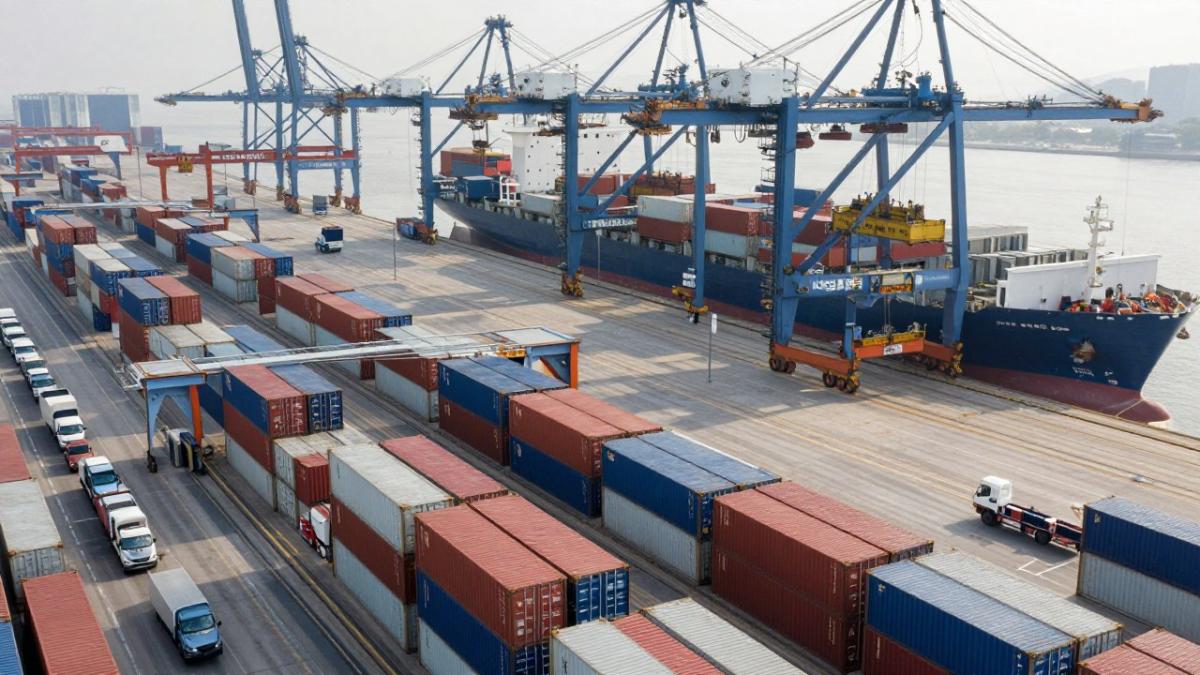
Port Pairs and What Drives the Difference
East Coast departures generally reach Cartagena and Barranquilla fastest. Gulf Coast ports serve the same destinations with slightly longer sailings. On the destination side, Cartagena handles the largest share of container traffic, while Santa Marta competes on natural deep-water access and infrastructure, according to a 2025 MDPI competitiveness analysis.
The spread in transit time comes from four mechanisms, not from distance alone:
- Direct sailing versus transshipment. A direct call from a U.S. East Coast port to Cartagena is the fastest pattern. Cargo that transships through a Caribbean hub adds days at the hub and a second handling cycle, which raises damage and delay risk.
- Sailing frequency. A port pair served weekly gives you more departure options than one served every two weeks. Less frequent service means a missed cutoff can cost you a full cycle.
- Port congestion. Cartagena and Barranquilla can back up during peak season. Congestion adds time at anchor and at the terminal, and it is the main reason a quoted transit time slips.
Port-to-Port Versus Door-to-Door: Two Different Clocks
A carrier's published transit time is port-to-port: from vessel departure at origin to discharge at destination. It excludes the days your container sits before loading, the days customs takes, and the trucking leg. When you compare quotes, confirm whether the transit time is port-to-port or door-to-door. A provider quoting 12 days port-to-port and a provider quoting 30 days door-to-door may be describing the same sailing.
How to Use Transit Time When Choosing a Route
If your cargo is time-sensitive, prioritize direct sailings and frequent service over the lowest ocean rate. If it is not, a transshipment route or a less congested port pair can save money at the cost of schedule certainty. Build a buffer into your delivery commitments: shippers commonly plan for some variability on any route, and more during peak season. Our Colombia shipping services page lists current routes and sailing options so you can compare port pairs before you book.
Colombia Import Rules, Customs Clearance, and Required Paperwork
Customs clearance is where unprepared shipments stall. Colombia requires an advance import declaration filed at least 48 hours before cargo arrives, per the International Trade Administration's Colombia import guide.
Your paperwork packet needs four documents:
- Commercial invoice showing value, terms, and parties
- Packing list detailing contents, weights, and dimensions
- Bill of lading issued by the carrier
Duties and taxes apply based on commodity classification and declared value. Confirm restricted and prohibited goods before you book, because some items cannot enter at all. A broker who knows Colombian rules is not optional for commercial cargo.
How to Book a Shipment: A Step-by-Step Process
Booking follows a predictable sequence. The shippers who avoid surprises are the ones who complete each step before moving to the next.
- Confirm cargo volume and weight using a CBM calculator so you pick the right container size.
- Compare rates across routes, equipment, and sailing schedules, checking what each quote includes.
- Verify import requirements and line up a customs broker before committing.
- Book the shipment and lock your departure date with the carrier.
- Prepare documentation and file the advance declaration at least 48 hours before arrival.
- Track the shipment through departure, transit, and destination port.
- Clear customs and arrange delivery to the final address.
Watch out: booking before confirming cargo volume is the most common and most expensive mistake, because switching container sizes after booking rarely comes free.
Personal Effects, Household Goods, and Vehicle Shipments
Personal effects and household goods move best in a shared or dedicated container, depending on volume. A relocating family with a full home often fills a 20-foot container; a smaller move fits LCL.
Vehicles follow a separate path. They need proper preparation, documentation, and a carrier experienced with roll-on/roll-off or containerized transport. Our vehicle shipping procedures guide covers preparation and delivery steps from pickup to final handover.
Get Your Instant Container Shipping Quote
The gap between a good quote and a bad one is usually information, not price.
As a licensed and bonded NVOCC and TSA-approved forwarder with 35 years of logistics experience, Freight-Calculator.com offers instant international shipping rates in under 30 seconds, with no registration required.
Get started with Freight-Calculator.com and see your real container shipping cost before you commit to a booking.
Frequently Asked Questions
How much does container shipping to Colombia cost?
Rates depend on container size, route, season, and what the quote includes. Headline prices are rarely comparable because some quotes exclude inland trucking and surcharges. Always confirm whether origin charges, destination charges, and customs fees are included before you compare two quotes side by side.
How long does container shipping to Colombia take?
Transit-time estimates vary with route, port pair, and service type, and should not be treated as a guaranteed schedule. Ports on the Caribbean coast, including Cartagena and Santa Marta, are common destinations for container services. Confirm the sailing schedule for your specific departure date before you commit to a delivery deadline.
What documents are needed to ship a container to Colombia?
Standard shipping paperwork includes a commercial invoice, packing list, and bill of lading. Colombia also requires an advance import declaration filed before cargo arrives; confirm the current deadline with a licensed customs broker. Personal effects and household goods shipments usually need additional documentation, and vehicles require separate import permits. Missing paperwork is the most common cause of customs clearance delays, so confirm the full document list with your forwarder before the container leaves origin.
Is FCL or LCL shipping better for cargo going to Colombia?
Full container load (FCL) suits shipments above roughly 15 cubic meters, fragile goods, and anything that needs to stay sealed from origin to destination. Less-than-container load (LCL) works for smaller volumes, typically under 5 CBM, where you pay only for the space you use. LCL adds consolidation time at both ends and means your cargo is handled more often. Compare the total landed cost of both options for your actual cargo volume rather than assuming one is cheaper.