 how-to
Calculate Air Freight Shipping Costs: Step-by-Step Guide
Table of Contents
- What Is Chargeable Weight in Air Freight?
- How to Calculate Volumetric Weight Using the Air Freight Dimensional Weight Formula
- Factors Affecting Air Freight Rates
- How to Get Accurate Air Freight Quotes
- Air Freight vs. Express Courier: Cost Comparison
- Common Mistakes to Avoid When Calculating Air Freight Costs
- Conclusion
Last Updated: August 16, 2026
What Is Chargeable Weight in Air Freight?
Chargeable weight is the value used to calculate your air freight bill, and it's often higher than the actual weight of your shipment. In air freight, carriers charge based on whichever is greater: the actual gross weight of your cargo or its volumetric weight (also called dimensional weight). This matters because aircraft have limited cubic space, and that space is valuable. A box of feathers takes up as much room in a cargo hold as a box of steel but weighs far less, so airlines charge by volume to prevent shippers from stuffing low-density cargo into massive boxes and paying pennies to ship them globally.
Understanding chargeable weight before you ship is essential. Many shippers discover this concept only after receiving a quote that's double what they expected.
How to Calculate Volumetric Weight Using the Air Freight Dimensional Weight Formula
The air freight dimensional weight formula is straightforward, but precision matters. A single measurement error compounds across your entire shipment cost.
Step 1: Measure Your Cargo Dimensions
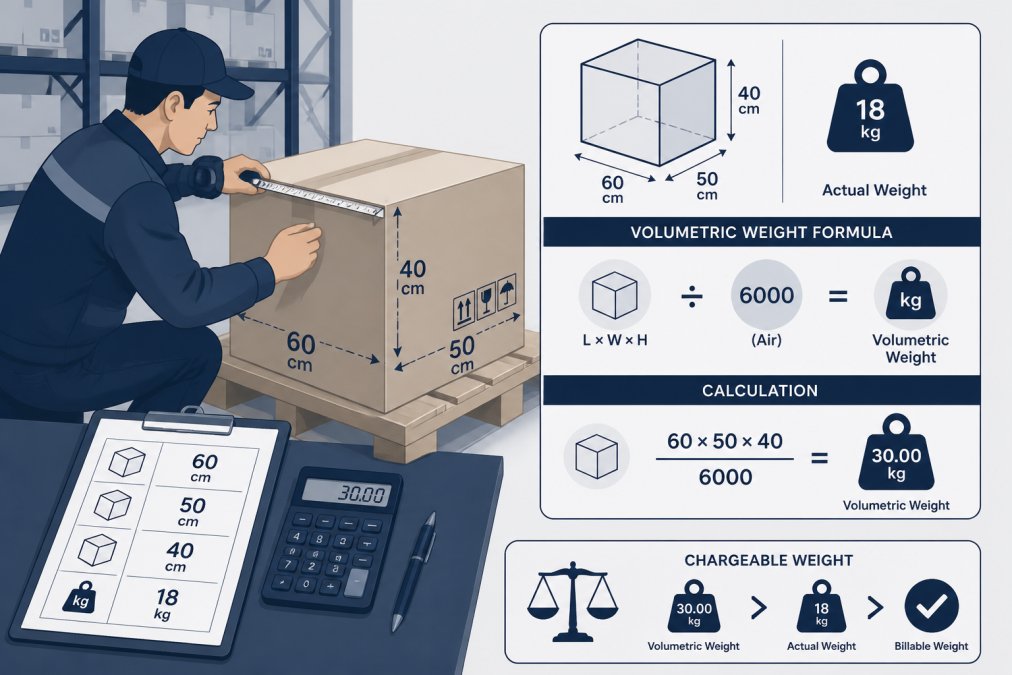
Measure length, width, and height of your shipment in centimeters. If your cargo isn't a single box, if it's palletized, on a skid, or multiple items, measure the outer dimensions of the entire consolidated unit. Use a tape measure, not estimation. For oddly shaped cargo, imagine the smallest rectangular box that would contain it, then measure that box. A 1 cm error on each dimension of a 100×100×100 cm pallet becomes a 3 percent error in total volumetric weight, meaningful when calculating costs across dozens of shipments.
Step 2: Apply the Dimensional Divisor
The standard dimensional divisor for air freight is 6,000. This number is set by the International Air Transport Association and used globally. Multiply length × width × height, then divide by 6,000.
Formula: (Length × Width × Height) ÷ 6,000 = Volumetric Weight in Kilograms
Example: A shipment measuring 100 cm × 80 cm × 60 cm.
- Calculation: (100 × 80 × 60) ÷ 6,000 = 480,000 ÷ 6,000 = 80 kg volumetric weight
Some carriers use slightly different divisors (5,000 or 5,500) for specific routes or premium services, but 6,000 is the industry standard. Always confirm the divisor with your freight forwarder before finalizing costs.
Step 3: Compare Gross Weight vs. Volumetric Weight
Now you have two numbers: the actual gross weight of your cargo and the volumetric weight you just calculated. Whichever is larger becomes your chargeable weight.
If your shipment weighs 60 kg but has a volumetric weight of 80 kg, your chargeable weight is 80 kg. If your shipment weighs 120 kg but has a volumetric weight of only 80 kg, your chargeable weight is 120 kg. This comparison determines your shipping strategy. High-volume, low-weight shipments (like electronics or clothing) are expensive on air freight routes because volumetric charges dominate. Dense shipments (machinery, metal parts) may be more cost-effective because actual weight is lower than volumetric weight.
Factors Affecting Air Freight Rates
Air freight pricing isn't determined by chargeable weight alone. The base rate per kilogram varies by route, season, fuel costs, and carrier capacity. A shipment from Los Angeles to Frankfurt costs differently than one from New York to Singapore. Peak seasons (November through January for e-commerce, spring for manufacturing) drive rates higher because cargo space fills quickly.
Carrier choice matters significantly. Major carriers like Lufthansa Cargo, FedEx International, and DHL Air offer different service levels and pricing. Smaller regional carriers sometimes offer competitive rates on specific lanes but less frequency.
Fuel Surcharges and Hidden Fees
Fuel surcharges are the most common hidden cost in air freight. When oil prices rise, carriers add surcharges (typically 2-15 percent of base rates). Beyond fuel, watch for airport handling fees, security surcharges, documentation fees, customs clearance charges, and destination delivery fees. A shipment quoted at $5 per kilogram can easily cost $6.50 per kilogram once all surcharges are applied.
Request a detailed rate breakdown before booking. Ask for the base rate, all applicable surcharges, and any fees not included in the per-kilogram price. Transparent freight forwarders will itemize everything upfront.
Shipping Lanes and Transit Time
Certain shipping lanes command premium rates because cargo space fills quickly. The Asia-to-North America lane, for example, typically costs more than reverse routing. Express air freight (24-48 hours) costs significantly more than standard air freight (3-5 days). If your timeline allows for standard service, you save substantially. Seasonal demand on specific lanes creates spikes; shipping consumer goods before the holiday season means higher rates and tighter capacity.
Incoterms Impact on Total Cost
Incoterms define who pays for freight, insurance, and customs clearance, and they directly affect your landed cost. Under FOB (Free on Board), the seller pays freight to the port but the buyer pays from there onward. Under CIF (Cost, Insurance, and Freight), the seller covers everything to the destination port. A supplier offering a lower price under FOB may actually cost more than one offering CIF, because you're paying additional freight and insurance yourself.
How to Get Accurate Air Freight Quotes
Getting accurate quotes requires clear communication about your cargo and expectations. Provide precise cargo information: exact dimensions (not estimates), actual weight, contents, packaging type, and any special handling requirements. Specify your timeline and state your destination clearly, including any special requirements.

Optimize Packaging to Lower Shipping Costs
Packaging optimization is one of the most underutilized cost-reduction strategies in air freight. Reducing dimensions directly reduces volumetric weight, which directly reduces chargeable weight. Eliminate excess packaging and use boxes that fit your product with minimal padding. Consider collapsible packaging or vacuum-sealed bags for soft goods, reducing volume by 40-60 percent. Palletization also matters; wrapping boxes tightly on a pallet creates a compact unit with minimal wasted space. A well-palletized shipment might reduce volumetric weight by 15-25 percent compared to loose packaging.
Using an Instant Shipping Calculator
An instant shipping calculator eliminates guesswork and speeds up cost estimation. The best calculators show you more than just the final price, they break down the chargeable weight calculation, show base rates and surcharges separately, and let you compare multiple routes or carriers side by side.
Freight-Calculator.com offers registration-free instant quotes for air freight shipments, showing you exact pricing without requiring you to create an account or wait for a sales call. You can input your cargo dimensions, see the volumetric weight calculation in real time, and compare rates across different shipping lanes and carriers, all in under 30 seconds. By testing different packaging dimensions or comparing express versus standard service, you can optimize costs before committing to a shipment.
Air Freight vs. Express Courier: Cost Comparison
Air freight and express courier services (FedEx International Priority, DHL Express, UPS Worldwide Express) both move cargo quickly but operate under different economics. Express couriers charge by weight, not volumetric weight. For small, heavy shipments, this is advantageous. Air freight charges by chargeable weight (whichever is larger: actual or volumetric). For large, lightweight shipments, air freight is typically cheaper.
Express couriers include door-to-door service, customs clearance, and tracking in their price. Air freight typically covers airport-to-airport movement, with additional charges for ground transport, customs, and delivery. Express courier guarantees 2-3 day delivery worldwide; air freight standard service takes 3-5 days. For e-commerce and manufacturing, air freight is usually more cost-effective for volumes above 50 kg. For urgent shipments under 20 kg, express courier often wins.
Common Mistakes to Avoid When Calculating Air Freight Costs
The most common mistake is measuring cargo carelessly. Shippers round dimensions down, estimate rather than measure, or forget to include packaging. A 5 cm underestimation on each dimension reduces measured volume by about 15 percent, leading to quotes that don't match reality.
Another frequent error is forgetting surcharges in cost comparisons. Always request itemized quotes and compare total cost, not just base rates. Shippers also neglect to account for Incoterms when comparing supplier prices. Failing to optimize packaging is another costly mistake; testing smaller box dimensions on a pilot shipment often reveals 10-20 percent cost savings that scale across thousands of orders. Finally, shippers often book with the first carrier that responds rather than comparing options. Spending 20 minutes comparing three quotes can save hundreds of dollars per shipment.
Getting air freight costs right requires understanding chargeable weight, measuring cargo accurately, and comparing total landed costs, not just per-kilogram rates. The calculation itself is simple: multiply dimensions, divide by 6,000, compare to actual weight, and use the larger figure. The real skill is optimizing packaging, understanding surcharges, and choosing the right carrier for your specific needs.
Freight-Calculator.com simplifies this process by providing instant, transparent air freight quotes without requiring registration. Input your cargo dimensions and destination, and see exact chargeable weight calculations and pricing breakdowns in seconds. This removes the guesswork from cost estimation and gives you the data you need to negotiate better rates with carriers or optimize your packaging strategy. Get started today and compare your current shipping costs against real-time market rates.
Frequently Asked Questions
What is the formula for calculating volumetric weight in air freight?
The standard air freight dimensional weight formula is length × width × height ÷ 6,000 (in inches) or length × width × height ÷ 5,000 (in centimeters). This gives you the volumetric weight. If this exceeds your cargo's actual gross weight, carriers charge based on the higher volumetric weight. This dimensional factor reflects how much space your shipment takes up relative to its actual mass, affecting your chargeable weight.
How do factors affecting air freight rates impact my total shipping cost?
Air freight rates depend on multiple factors: chargeable weight (actual or volumetric, whichever is higher), fuel surcharges (typically 10-30% of base rate), destination airport, cargo classification, handling requirements, and current shipping lanes. Customs clearance and documentation fees also add to costs. Peak season rates are higher than off-season. Using an instant shipping calculator accounts for these variables to give you an accurate estimate before you commit.
Why is my actual weight different from my volumetric weight?
Actual gross weight is what your cargo physically weighs in kilograms or pounds. Volumetric weight (dimensional weight) is calculated from the space it occupies. Light, bulky items often have higher volumetric weight than actual weight. Air carriers charge based on whichever is greater, the chargeable weight. This prevents shippers from filling planes with lightweight cargo while wasting space.
How can I get an accurate air freight quote without surprises?
Request quotes that break down all components: base rate, fuel surcharge, customs clearance fees, documentation charges, and any handling surcharges. Use an instant shipping calculator that shows real-time rates. Provide exact cargo dimensions, weight, and destination. Ask about Incoterms (whether you or the carrier covers insurance and customs). Verify the freight forwarder is licensed and bonded. Compare quotes from multiple sources, and confirm all fees before booking to avoid hidden costs.
This article was written using GrandRanker